The short answer
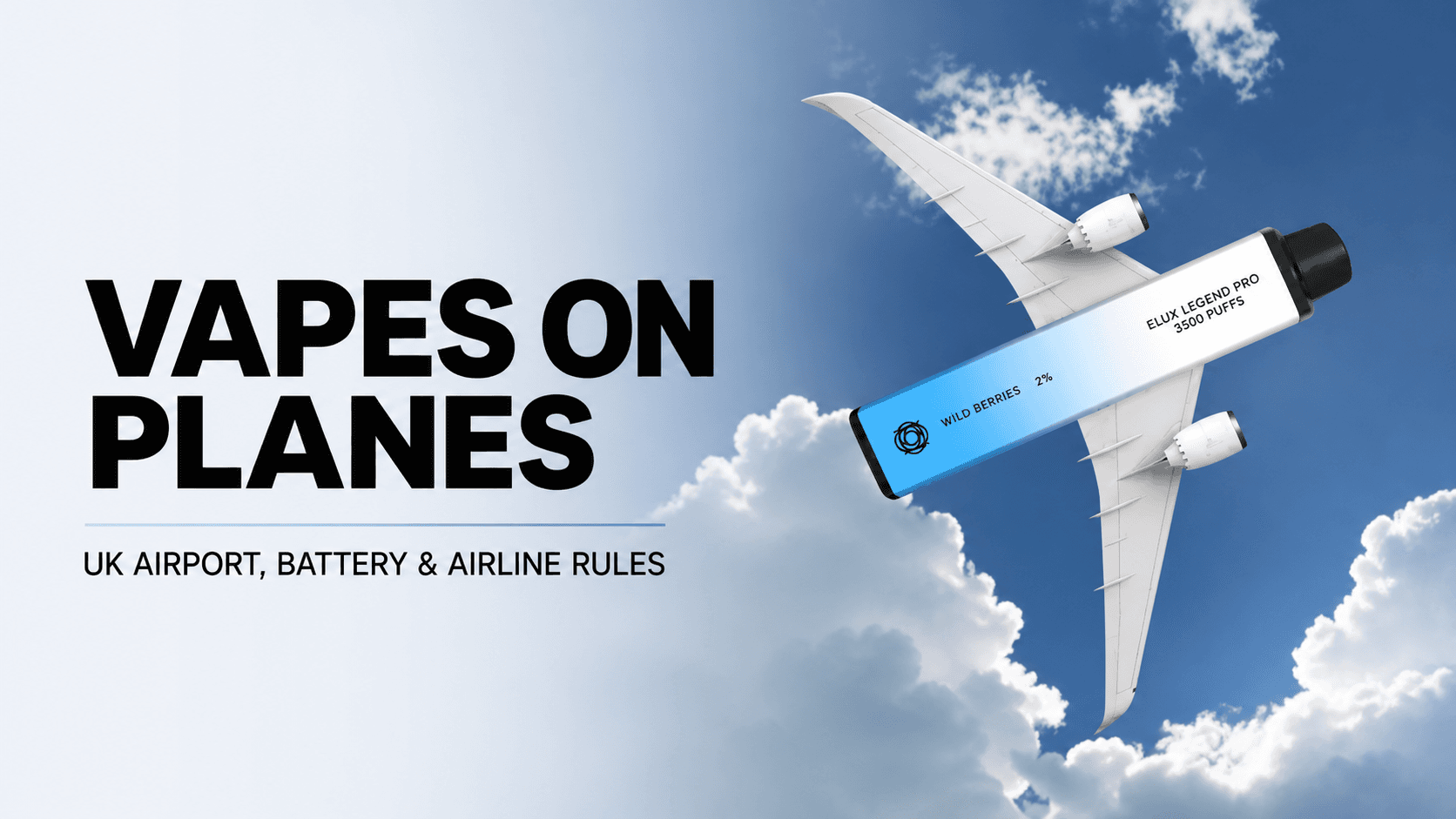
You can normally take a vape on a flight from the UK, but the device must stay in the cabin and must not go in checked hold baggage. Protect it from accidental activation, protect loose battery terminals from short circuits, and do not use or recharge the device onboard. Your airline can set tighter conditions.
E-liquid is a separate question. The security limit depends on the airport and itinerary. Heathrow and Gatwick currently permit liquid containers up to 2 litres, while Manchester currently keeps a 100ml-per-container limit. Return and transfer airports may apply different rules. Finally, an airline allowing the device onboard does not make it legal at your destination or transit point.
Key points
- Keep the vape device and spare batteries in the cabin, never in checked hold baggage.
- Switch the device fully off, prevent accidental firing, and protect loose battery terminals from short circuits.
- Do not use or recharge a vape onboard, and follow the crew and airline instructions.
- Check the departure, transfer, and return airports because cabin-liquid limits now differ.
- Check destination and transit law separately because airline acceptance is not permission to import or possess a vape.
There is no single rule called the UK vape flight rule. Four authorities can affect the same journey: airport security decides what passes the checkpoint, the airline decides what it will carry, cabin rules control conduct onboard, and local law controls what may enter or be possessed at the destination. A connection can add another airport and another legal system.
This guide is for an adult carrying a lawful personal-use nicotine vape from a UK airport. It does not cover commercial quantities, cannabis or THC products, improvised devices, or damaged batteries. For conduct away from the aircraft, read the UK public-vaping guide. Check a product before packing with the fake-vape safety guide, and use the e-liquid format guide if bottle labels are unclear.
The four checks that decide whether you can travel with a vape
| Comparison point | Who controls it | Question to answer | Where to verify |
|---|---|---|---|
| Security screening | Departure or transfer airport and national security authority | Can this device and these liquid containers pass the checkpoint? | The airport security page for that terminal and date |
| Baggage carriage | Airline, informed by aviation dangerous-goods rules | Where must the device and spare batteries travel, and how many are accepted? | Your operating airline, not only the company that sold the ticket |
| Use in the terminal and aircraft | Airport operator, airline, and cabin crew | Where is vaping allowed, and must the device remain switched off? | Airport smoking policy and airline restricted-items page |
| Import, possession, and local use | Destination and transit-country authorities | May the product enter the country or be possessed and used there? | Current FCDO advice plus the destination authority or embassy |
Important context: Passing one check does not satisfy the other three. Recheck shortly before travel because liquid limits, airline policies, and local laws can change.
Why the vape stays out of the hold
The UK Civil Aviation Authority lists battery-powered electronic smoking devices as not allowed in checked baggage. They can travel in the cabin subject to restrictions. The device must not be recharged onboard, must be protected against unintended activation, and must use a battery within the stated lithium limits. Spare batteries must also stay in cabin baggage and each one must be protected against a short circuit.
The practical reason is visibility and response. A battery fault, overheating event, or fire is easier for crew to detect and manage in the cabin than in an unattended bag in the cargo hold. The CAA separately advises passengers not to carry any battery that is damaged, swollen, or showing signs of overheating.
UK Civil Aviation Authority passenger baggage guidanceEvidence checked 2026-08-06
Limitation: The CAA provides the safety baseline. The operating airline may impose a lower quantity limit, specify where the device must be kept, or refuse an item it cannot verify as safe.
Pack a vape for a flight in seven checks
Confirm the entire itinerary first
List the departure, every connection, the destination, the return airport, and each operating airline. Check all of them, including a country where you only change aircraft.
Inspect the device and batteries
Do not fly with a swollen, damaged, leaking, recalled, or overheating device or cell. Keep manufacturer markings visible so airline staff can identify the battery specification if asked.
Switch off and prevent activation
Turn the device fully off, not merely locked if its instructions distinguish the two. Use a rigid case or another method that prevents buttons being pressed. Follow the manufacturer and airline guidance for pods or tanks.
Protect every removable cell
Carry spare cells in their original packaging or in individual battery cases. Never leave loose cells beside keys, coins, or other metal objects. Tape exposed terminals only where the battery or airline guidance permits it.
Pack e-liquid for the strictest checkpoint
Check the container limit at the outbound, connection, and return airports. Keep caps secure, leave expansion space where practical, and place bottles in a leak-resistant bag even when security does not require a clear liquids bag.
Keep the device accessible in the cabin
Put it where you can remove it if a cabin bag is taken at the gate. Do not bury a vape or spare cells in a bag that may be moved into the hold.
Follow staff instructions on the day
Security staff and the airline make the operational decision. Declare the item when asked, move it to the required bag, and do not argue from an old screenshot or a rule from another airport.
E-liquid rules now depend on the airport
The familiar 100ml rule is no longer a safe summary for every UK departure. GOV.UK tells passengers to check the airport because security-liquid rules have changed at some locations. As checked on 6 August 2026, Heathrow says containers up to 2 litres can remain in cabin baggage across Terminals 2, 3, 4, and 5. Gatwick also says most liquid containers can hold up to 2 litres. Manchester Airport still says each hand-luggage liquid must be under 100ml.
A standard 10ml UK nicotine-liquid bottle fits within either example, but that does not remove the need to check. A larger shortfill, a connecting airport, a return airport, or a route-specific restriction can change what passes security. The container size matters, not how little liquid remains in an oversized bottle.
Security screening and legal import are separate. A bottle that passes Heathrow security may still be prohibited by the destination. Likewise, putting liquid in checked baggage avoids a cabin-security size issue but does not bypass airline dangerous-goods rules, customs controls, or local vape law. Pack only a reasonable personal quantity and ask the airline if its policy is unclear.
Carrying a vape does not mean you may use it
Airport policy applies before boarding. Do not assume a smoking area accepts vaping, or that an outdoor-looking airside space permits it. Use only a location the airport identifies for smoking or vaping. For example, Stansted states that e-cigarette use is forbidden within the airport, while Heathrow operational guidance identifies limited designated airside smoking and vaping facilities in particular terminals. Facilities can close or change, so check the passenger information for your terminal on the day.
On the aircraft, do not vape. British Airways prohibits the use of personal vaporisers onboard. easyJet requires vaping devices to be completely switched off and prohibits recharging. The CAA also says electronic smoking devices and their batteries must not be recharged onboard. This includes connecting the vape to a seat socket or power bank.
Do not rely on stealth, a toilet, or a claim that the aerosol is harmless. The relevant point is the airline prohibition and crew authority, not whether a detector will react. Keep the device off and wait until you reach a location where local law and venue rules expressly allow use.
Decide what to pack from the strictest part of the itinerary
If your airport, airline, connections, and destination all permit the product
Carry a small, protected personal setup in the cabin
A switched-off device, securely packed liquid, and individually protected spare cells meet the central safety needs while remaining easy to remove if a bag is gate-checked.
Watch for: The operating airline can still set quantities, battery limits, or storage instructions, and security staff retain discretion.
If the outbound airport allows a larger liquid container but a connection or return airport does not
Pack to the strictest checkpoint
Using the smallest permitted containers avoids being compliant on departure but unable to clear security later in the trip.
Watch for: A security-compatible bottle can still be illegal to import or possess at the destination.
If your booking shows one airline but another operates a flight segment
Check the operating carrier for every segment
The aircraft operator applies the onboard and dangerous-goods policy. A codeshare seller cannot guarantee that another carrier accepts the same quantity or packing method.
Watch for: If policies conflict, obtain written clarification or leave the item behind rather than guessing at the airport.
If the destination or a transit country bans import or possession
Do not take the vape, pods, batteries, or e-liquid
Airline carriage permission does not override local law, and personal use or a short connection may not create an exemption.
Watch for: Use current official advice for the exact route. Do not rely on a forum post, an earlier trip, or the product being legal in the UK.
Common questions about flying with a vape
Can I put a vape in checked luggage?
No. UK CAA and GOV.UK guidance place e-cigarettes in cabin baggage and exclude them from checked hold baggage. If a cabin bag is moved to the hold at the gate, remove the device and spare batteries first and follow staff instructions.
Can I take e-liquid through UK airport security?
Usually, but check the specific airport and terminal. As of 6 August 2026, Heathrow and Gatwick permit most liquids in containers up to 2 litres, while Manchester keeps a limit below 100ml per container. Transfer and return airports may use different limits.
Do 10ml e-liquid bottles need a clear plastic bag?
That depends on the airport. Some upgraded UK checkpoints allow liquids to remain inside cabin baggage, while other airports retain different presentation rules. Check the current airport instructions instead of assuming that one UK process applies everywhere.
How many vapes can I take on a plane?
There is no responsible universal number. The CAA safety baseline, airline limits, security discretion, battery quantity, customs rules, and destination law all matter. easyJet and British Airways, for example, state a maximum of two spare lithium batteries in the relevant guidance. Check your operating carrier and carry only a reasonable personal quantity.
Can I charge my vape on the plane?
No. The CAA says electronic smoking devices and their batteries must not be recharged onboard. British Airways and easyJet also prohibit onboard recharging. Charge safely before travel and keep the device switched off during the flight.
Can I vape in an airport smoking area?
Only if that airport expressly permits vaping in that location. Airport policies differ. Some provide designated areas, while others prohibit e-cigarette use within the airport. Check the terminal map or ask airport staff before using the device.
Can I take a vape through a country where I only change planes?
Do not assume a connection is exempt from local rules. Whether you clear immigration, reclaim baggage, change terminals, or remain airside can matter, but only the relevant authorities can confirm the legal position. Check official advice for every transit point before packing.
Does the UK single-use vape sales ban stop me travelling with a reusable vape?
No, the UK sales and supply ban on single-use vapes is not a blanket ban on lawful reusable devices. Flight safety and destination rules still apply. Do not carry a product that is illegal, damaged, recalled, or prohibited anywhere on the itinerary.
Related reading
Sources and verification
- Pack right. Safe flight.UK Civil Aviation AuthorityChecked: 6 August 2026
Supports: Cabin carriage of vapes and spare batteries, removal from gate-checked bags, damaged-battery precautions, and airline checks.
- What items can I travel with and which are restrictedUK Civil Aviation AuthorityChecked: 6 August 2026
Supports: Detailed electronic smoking-device rules covering cabin carriage, no onboard recharging, activation protection, battery limits, and short-circuit protection.
- Hand luggage restrictions at UK airportsUK GovernmentChecked: 6 August 2026
Supports: Airport-specific liquid-rule warning, transfer-airport checks, security discretion, and airline baggage checks.
- Hand baggage and liquidsHeathrow AirportChecked: 6 August 2026
Supports: Current Heathrow security process and allowance for liquids in containers up to 2 litres across Terminals 2, 3, 4, and 5.
- Security screeningLondon Gatwick AirportChecked: 6 August 2026
Supports: Current Gatwick security process allowing most liquid containers up to 2 litres to remain in hand luggage.
- Guide to going through securityManchester AirportChecked: 6 August 2026
Supports: Current Manchester Airport limit of less than 100ml per liquid container in hand luggage and stated exemptions.
- Restricted and prohibited itemsBritish AirwaysChecked: 6 August 2026
Supports: Airline example for cabin carriage, accidental-activation protection, onboard-use prohibition, liquids, gate-checked bags, and destination-law checks.
- Dangerous Goods and Prohibited ArticleseasyJetChecked: 6 August 2026
Supports: Airline example requiring devices in the cabin, switched off and protected from activation, with no onboard recharging and a two-spare-battery limit.
- Prohibition of Smoking and Vaping in Airside AreaHeathrow AirportChecked: 6 August 2026
Supports: Heathrow airside prohibition and the limited designated passenger smoking and vaping facilities identified by terminal.
- Smoking within the terminalLondon Stansted AirportChecked: 6 August 2026
Supports: Current Stansted statement that e-cigarette use is forbidden within the airport.
- Thailand travel advice: safety and securityForeign, Commonwealth and Development OfficeChecked: 6 August 2026
Supports: Current warning that possession or use of vapes, pods, e-liquid, and related devices is illegal in Thailand, including for tourists and personal use.
- Singapore travel advice: safety and securityForeign, Commonwealth and Development OfficeChecked: 6 August 2026
Supports: Current warning that bringing vapes or e-cigarettes into Singapore for personal use is illegal.
Editorial record
- Last reviewed
- 6 August 2026
- Next review due
- 6 September 2026
What changed
Replaced universal liquid, quantity, airport-use, charging, and destination claims with a four-check travel framework. Added current CAA battery rules, airport-specific liquid examples, airline examples, gate-check guidance, and official destination-law checks.
Disclosure
Vape Forest sells vaping products. This guide summarises public travel rules for personal-use products but cannot confirm acceptance for a particular flight, airport, connection, or destination. Check each authority before travel.