
What Vaping Products Duty actually is
Vaping Products Duty is a UK excise duty charged at 22p per millilitre on vaping liquid manufactured in, or imported into, the UK. The duty point can occur at manufacture, import or release from duty suspension. Read HMRC's duty guidance.
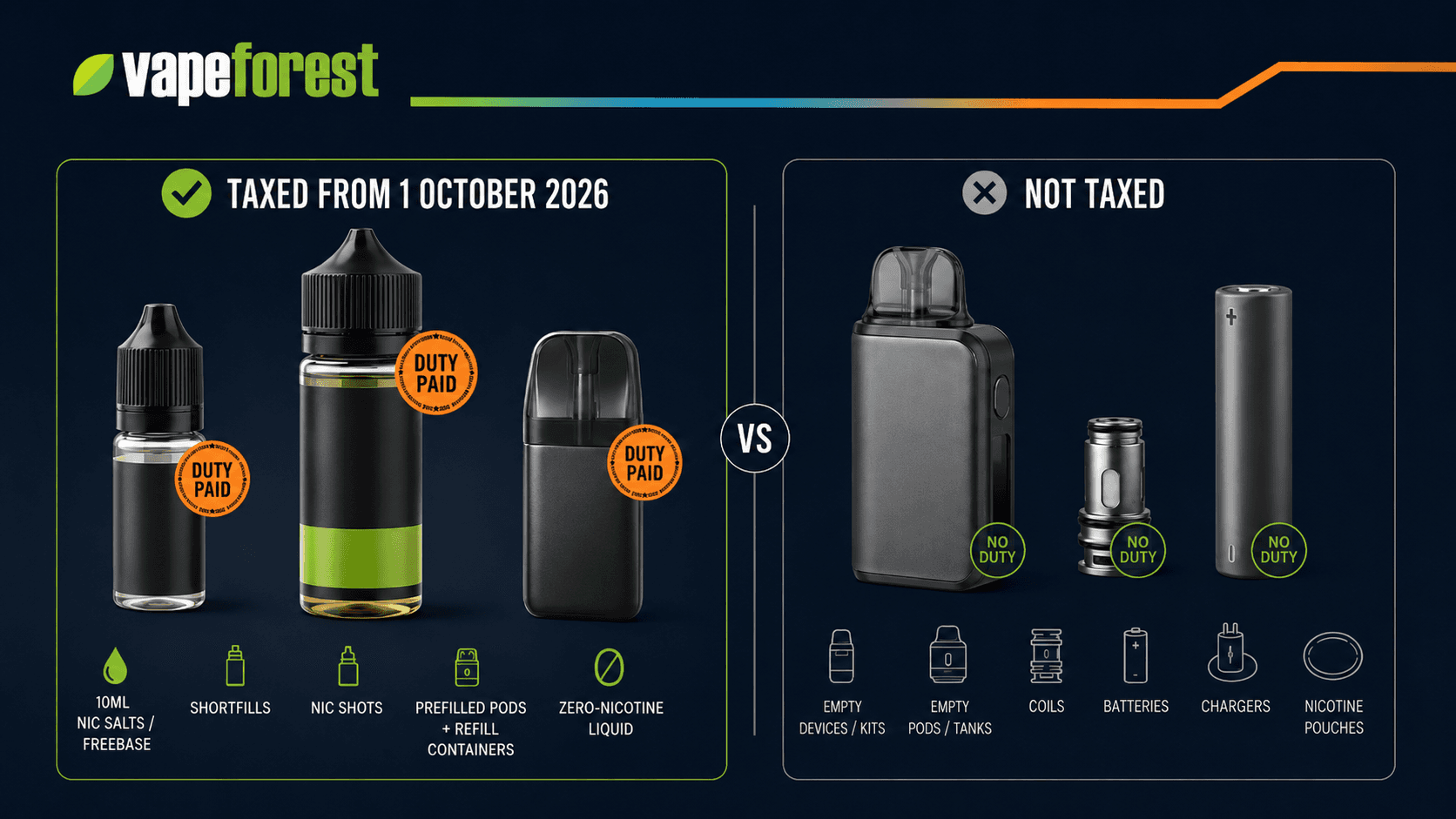
The rate is the same for nicotine and nicotine-free liquid. It covers bottled e-liquid, shortfills, nicotine shots and liquid already contained in prefilled pods or devices. Empty hardware is outside the duty.
The 26.4p-per-ml figure used in our examples is not a second statutory rate. It is 22p plus 20% VAT on that duty, assuming the whole amount is added to the existing VAT-inclusive retail price. Base prices, margins and promotions can still change, so the law creates no minimum shelf price. See HMRC's VAT guidance.
Within Vaping Products Duty
- Nicotine salts and freebase e-liquids
- Nicotine-free e-liquids and shortfills
- Nicotine shots, including bundled shots
- Liquid inside prefilled pods and devices
Outside Vaping Products Duty
- Empty vape kits and devices
- Empty replacement pods and tanks
- Coils, batteries and chargers
- Nicotine pouches: no separate UK pouch duty is enacted as at 9 August 2026
Key dates and the stamp transition
March 2024
Duty announced
The Spring Budget announced a new duty on vaping products from October 2026.
October 2024
Flat £2.20 per 10ml rate confirmed
The Autumn Budget replaced the proposed nicotine-strength bands with one flat rate.
1 April 2026
HMRC applications opened
Businesses that need Vaping Products Duty approval could begin applying.
1 September 2026
Transitional stamps can be used
Approved businesses can begin using transitional stamps before the duty starts.
1 October 2026
Duty starts and new releases must be stamped
Vaping products released for UK consumption from this date are liable for duty and must carry a stamp.
31 March 2027
Pre-duty stock grace period ends
This is the final day qualifying stock released before 1 October 2026 may be sold without a stamp.
1 April 2027
Stamp requirement applies across the market
Vaping products outside duty suspension must carry the required stamp.
Source: HMRC preparation guidance.
Vape duty calculator: an illustrative cost scenario
Fixed Vape Forest price snapshot from 13 July 2026
Snapshot monthly liquid cost
£38
Estimated after full pass-through
£78
Illustrative extra per month
+£40
Illustrative extra per year
+£482
Difference between buying 3 months at the snapshot price and the full-pass-through scenario:
£120
Shop 10ml bottles on multibuyThis model adds 22p duty per ml and 20% VAT on that duty to a fixed catalogue snapshot. It assumes full pass-through, not a legal minimum or a forecast. Actual prices may differ. Vaping totals exclude devices, coils, batteries and other replacement parts.
Illustrative full-pass-through price effects
The table adds 22p duty per ml and 20% VAT on that duty to our 13 July 2026 prices. It does not predict what Vape Forest or another retailer will charge.
| Snapshot product | Snapshot price | Duty plus VAT scenario | Full-pass-through illustration |
|---|---|---|---|
| 10ml e-liquid (single bottle) | £2.99 to £3.99 | +£2.64 | £5.63 to £6.63 |
| 4 for £10 multibuy (40ml) | £10.00 | +£10.56 | £20.56 |
| 10 e-liquids for £18 (100ml) | £18.00 | +£26.40 | £44.40 |
| 100ml shortfill plus two 10ml nic shots | £14.99 | +£31.68 | £46.67 |
| Prefilled pod plus 10ml refill (12ml) | £5.99 | +£3.17 | £9.16 |
Tobacco and vaping duty follow different histories
Tobacco
Tobacco products already carry established excise duties that have been uprated repeatedly. Their exact rates and structures differ by product.
Vaping liquid
The UK moves from no dedicated vaping excise duty to a flat 22p per ml on 1 October 2026. That is a single policy start date, but it does not justify inventing an indexed comparison with tobacco.
The government plans a one-off tobacco-duty increase alongside the new vaping duty to help preserve the financial incentive to switch. See the official policy impact note.
Why shortfills face a larger cash charge
Duty is based on volume, so a larger bottle creates a larger cash liability even when its current price per millilitre is low. A 100ml shortfill creates £22 of duty before VAT. Two 10ml nicotine shots add another £4.40 of duty before VAT, even if they were previously bundled without a separate charge.
In our snapshot example, £14.99 plus the full duty-and-VAT effect on all 120ml is £46.67. That exact sum is a scenario, not a forecast. A seller could change the base price, bundle or margin.
Snapshot bundle
£14.99
Duty on 120ml
£26.40
VAT on that duty
£5.28
Illustrative total
£46.67
Monthly liquid-cost scenarios
These examples use 30.4 days per month and the 4-for-£10 snapshot format. They assume full pass-through and exclude hardware and replacement parts.
| Illustrative use | Daily liquid | Snapshot monthly | Full-pass-through monthly | Illustrative extra/year |
|---|---|---|---|---|
| Light | 5ml | £38 | £78 | £482 |
| Medium | 10ml | £76 | £156 | £963 |
| Heavy | 15ml | £114 | £234 | £1,445 |
Do not raise nicotine strength solely to reduce tax. If you want to reduce liquid use or stop smoking, get appropriate advice and read the NHS guidance on using vapes to quit smoking.
Separate vaping-liquid and smoking-cost scenarios
The rows below place independent examples side by side for orientation. They do not claim that a given number of millilitres is equivalent to a given number of cigarettes. Smoking assumes £15 per pack of 20; vaping uses the full-pass-through multibuy scenario.
| Illustrative row | Vaping liquid use | Liquid-only monthly cost | Cigarette use | Cigarette monthly cost |
|---|---|---|---|---|
| A | 5ml/day | £78 | 10/day | £228 |
| B | 10ml/day | £156 | 15/day | £342 |
| C | 15ml/day | £234 | 20/day | £456 |
Uses 30.4 days per month. The vaping column excludes devices, coils, batteries and other replacement parts. £15 per cigarette pack is an explicit assumption, not a claimed UK average.
A limited UK and Ireland comparison
Cross-country league tables can mislead when they mix dates, exchange rates and different product scopes. The confirmed native rates below are a selected comparison, not a European ranking.
United Kingdom
£0.22/ml
Starts 1 October 2026.
Ireland
€0.50/ml
Commenced 1 November 2025.
Ireland's official rate and date are confirmed by its Department of Finance. It is too early, and this guide has no evidence, to attribute specific price, cross-border or illicit-market behaviour to that duty.
Why the government is introducing the duty
Discourage non-smokers and young people
The stated policy aim is to reduce the affordability of vaping products for young people and non-smokers.
Support tobacco-control policy
The government pairs the new duty with a tobacco-duty increase intended to preserve an incentive to switch.
Raise revenue
The official forecast is approximately £565 million in 2030–31, subject to behavioural and market uncertainty.
These are stated objectives and forecasts, not guaranteed outcomes. Read the official impact assessment.
Duty stamps, enforcement and the transition
A vaping duty stamp is a secure physical stamp on the outermost retail packaging. It includes a digital data matrix code; it is not a digital-only label. Approved businesses may use transitional stamps from 1 September 2026.
Products released for consumption from 1 October 2026 must be duty-paid and stamped. Qualifying pre-1 October stock can be sold without a stamp through 31 March 2027. From 1 April 2027, vaping products outside duty suspension must carry a stamp. Read HMRC's stamp guidance.
The Tobacco and Vapes Act 2026 provides powers for retail licensing, but scheme details require further regulations and consultation. It is therefore inaccurate to present a finished UK-wide licensing scheme as already operating. See the government's Act update.
How to check compliance without inventing price floors
Price alone is not proof
Duty creates a tax cost, but it does not set a minimum retail price. Discounts, clearance stock, margin decisions and the transitional period can all affect shelf prices.
- From 1 April 2027, check that the outermost retail packaging carries the required stamp.
- Buy from a reputable supplier that can explain the product’s provenance.
- Keep a receipt and check that packaging, batch details and safety information are intact.
- During the transition, remember that qualifying older unstamped stock may remain lawful only through 31 March 2027.
DIY mixing and duty
HMRC says making vaping liquid at home from non-duty-paid ingredients requires approval even for personal use; there is no personal-use exemption. Mixing components that were already duty-paid, such as a duty-paid shortfill and duty-paid nicotine shot, is permitted. Concentrated nicotine is hazardous and should not be handled without suitable knowledge and safeguards. Check HMRC's exact preparation rules.
What the rules mean for retailers
A retail-only shop that buys and resells duty-paid products does not normally need Vaping Products Duty approval or pay the duty itself. It should buy from approved, traceable suppliers, check stamps when required and keep appropriate purchase and sales records.
HMRC says records relevant to the duty generally need to be kept for at least six years. Manufacturers, importers, businesses holding goods in duty suspension and some wholesalers have separate approval, accounting and payment duties. Higher duty-paid wholesale values may also increase the working capital tied up in stock, but the effect will vary by business.
This distinction matters: it is inaccurate to imply that every retailer must register, apply stamps or pay excise upfront. Read HMRC's retailer guidance.
Practical preparation before October 2026
Plan around products you already use and your normal budget. Do not overbuy solely because a calculator displays a large scenario difference.
Check dates before buying extra
Look at the best-before information and manufacturer storage instructions. Buy only an amount you reasonably expect to use.
Understand the sell-through window
Qualifying products released before 1 October 2026 may be sold without stamps only through 31 March 2027.
Get advice before changing nicotine use
Do not increase nicotine strength just to reduce liquid use. Seek appropriate stop-smoking or healthcare advice.
Check stamps and provenance, not price thresholds
From 1 April 2027, use the required stamp, intact packaging, a receipt and a reputable supply chain as compliance signals.
Browse current catalogue prices
Current listings are separate from the guide's future-price scenarios.
Sources and methodology
How to read the numbers
- Confirmed rule: 22p per ml from 1 October 2026, including nicotine-free vaping liquid.
- Vape Forest estimate: 26.4p per ml assumes full pass-through of the duty plus 20% VAT on that duty.
- Price baseline: fixed Vape Forest catalogue snapshot dated 13 July 2026; it is not live pricing.
- Monthly convention: daily use multiplied by 30.4. Vaping totals exclude hardware and replacement parts.
- No figure on this page is presented as a legal minimum price or a guaranteed future shelf price.
Primary official sources
UK vape tax FAQ
When does the UK vape tax start?
Vaping Products Duty starts on 1 October 2026. Products released for UK consumption from that date must be duty-paid and stamped. Qualifying stock released before 1 October can continue to be sold without a stamp until 31 March 2027; from 1 April 2027, vaping products outside duty suspension must be stamped.
How much is the UK vape tax per bottle?
The statutory duty is 22p per millilitre. That is £2.20 on 10ml and £22 on 100ml before considering VAT or any other price change. Our illustrations show 26.4p per millilitre only as a scenario in which the whole duty and 20% VAT on it are passed through to the customer. Actual shelf prices are set by each seller.
Are vape devices and coils taxed too?
No. Vaping Products Duty applies to vaping liquid, including liquid already contained in a pod or device. Empty devices, tanks, coils, batteries and chargers are outside the duty.
Is nicotine-free e-liquid included in the vape tax?
Yes. The flat rate applies to vaping liquid with or without nicotine, including zero-nicotine shortfills. Nicotine strength does not change the rate.
Will multibuy deals like 4 for £10 still exist?
Retailers will decide their own future offers. Using the 13 July 2026 4-for-£10 snapshot, adding 22p duty per millilitre plus 20% VAT on that duty produces an illustrative total of £20.56. This is a calculation scenario, not a promised future deal or a legal minimum price.
Is vaping still cheaper than smoking after the 2026 tax?
It can be, but the answer depends on individual use and future prices. Our table compares separate illustrative scenarios: a vaper using 10ml a day would spend about £156 a month on liquid under the full-pass-through multibuy scenario, while 15 cigarettes a day at an assumed £15 per pack would cost about £342. The vaping figure excludes devices, coils and other replacement parts, and the two usage levels are not claimed to be equivalent.
Can I stock up on e-liquid before October 2026?
You can buy lawful products before the start date, but only buy amounts you expect to use, check each product’s best-before information and follow its storage instructions. Retailers can sell qualifying pre-1 October stock without a stamp only until 31 March 2027.
What are vaping duty stamps?
They are secure physical stamps placed on the outermost retail packaging. Each stamp includes a digital data matrix code that authorised users can scan for product data. Transitional stamps can be used from 1 September 2026; products released for consumption from 1 October must be stamped, with a limited sell-through period for qualifying older stock.
Does a very low price prove that duty has not been paid?
No. The law sets a duty liability, not a minimum retail price. A low price alone does not prove that a product is illicit. From 1 April 2027, the required stamp, traceable provenance, a receipt and a reputable supplier are more useful compliance checks than an invented price threshold.
Can I mix my own e-liquid to avoid the duty?
HMRC says there is no personal-use exemption for making vaping liquid from ingredients on which duty has not been paid: approval is required even when mixing at home. You may mix components that were already duty-paid, such as a duty-paid shortfill and duty-paid nicotine shot. Concentrated nicotine also presents serious handling risks.
Does a retail-only vape shop need Vaping Products Duty approval?
A shop that only buys and resells duty-paid products does not normally need Vaping Products Duty approval or to pay the duty itself. It must source compliant goods, check stamps when required and keep appropriate records. Manufacturing, importing, holding goods in duty suspension and certain wholesale activities have different HMRC obligations.
Editorial and compliance note
Vape Forest will follow applicable HMRC requirements and source traceable, compliant stock. Policy facts on this page are linked to primary official sources. Price effects are visibly labelled estimates based on the 13 July 2026 snapshot and a full-pass-through assumption.
Last updated 9 August 2026. This guide is general information, not legal, tax, medical or financial advice. You must be 18 or over to purchase vaping products in the UK.