The short answer
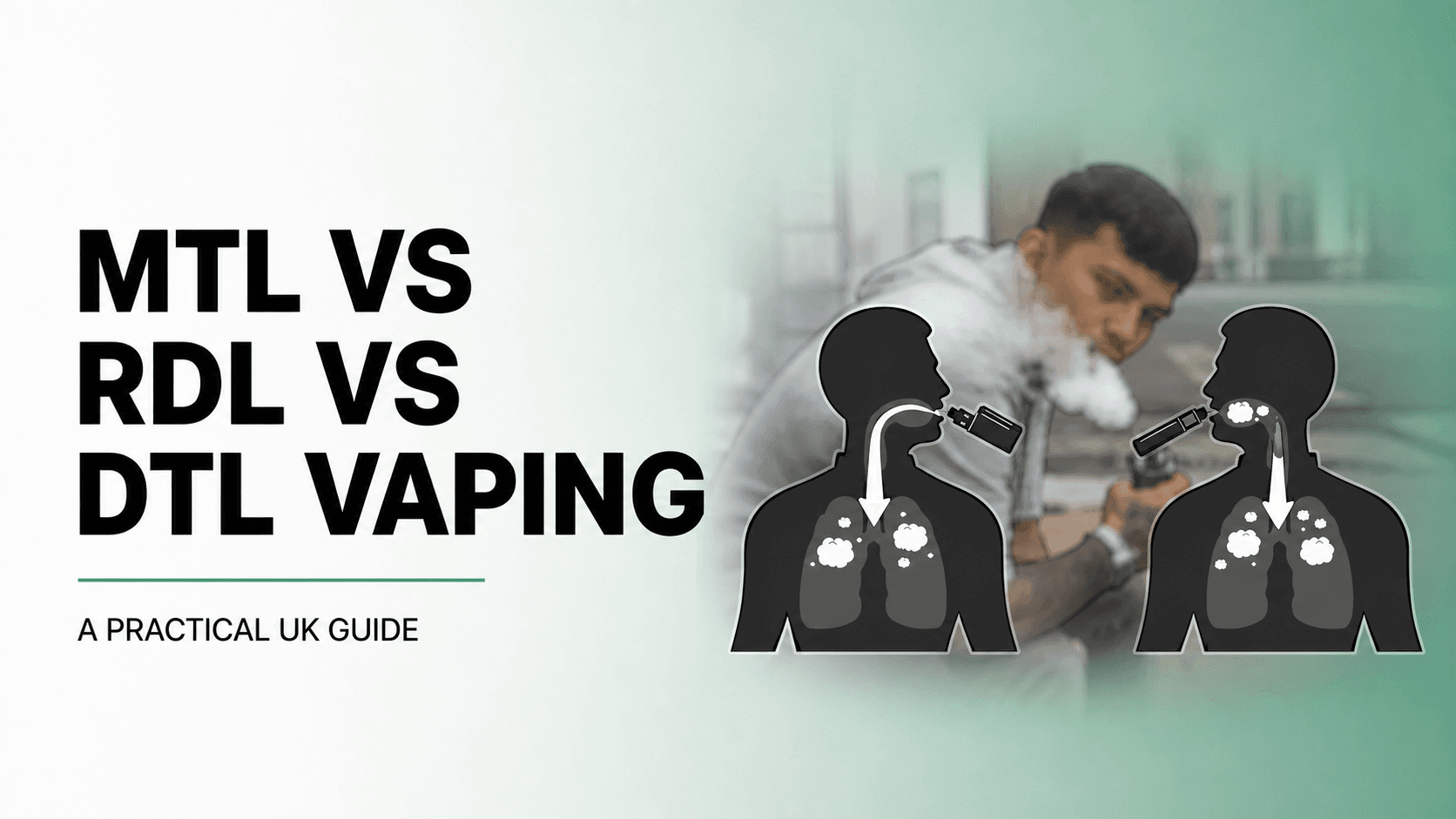
MTL, RDL, and DTL describe how you inhale and how open the airflow feels, not a universal safety ranking. Mouth-to-lung, or MTL, draws aerosol into the mouth before inhaling and usually uses tighter airflow and lower power. Restricted direct-to-lung, or RDL, inhales directly through a partly restricted airflow. Direct-to-lung, or DTL, uses an open direct inhale and usually produces more aerosol per draw at higher power.
Choose the draw first, then use a device, pod or coil, power setting, e-liquid composition, and nicotine strength that the manufacturer supports for that setup. Coil resistance alone cannot classify every draw style. An adult switching from smoking may find MTL familiar, but the useful choice is the one that controls cravings, is comfortable, and supports a complete switch without incompatible liquid or improvised settings.
Key points
- MTL pauses in the mouth before inhaling; RDL and DTL inhale directly with restricted or open airflow.
- Airflow, coil design, power, liquid viscosity, nicotine concentration, and puffing all interact.
- Resistance is one electrical specification, not a universal label for inhale style or safety.
- More open, higher-output setups usually aerosolise more liquid per draw, so nicotine strength cannot be copied blindly from an MTL pod.
- For an adult stopping smoking, craving control and complete switching matter more than belonging to an MTL or DTL camp.
MTL and DTL are often presented as two boxes separated by a 1-ohm line. Modern pod systems make that shortcut unreliable. A 0.6-ohm pod can be used for a tight or restricted draw in one platform, while a different coil at the same resistance may be designed for more airflow and power. RDL fills the real middle ground that the two-box explanation misses.
This guide starts with the sensation and air path, then adds the hardware. If you want current low-power options after deciding that MTL suits you, see the method-led MTL kit guide. Use the e-liquid selection guide for liquid formats and the sub-ohm guide before moving to higher-output hardware.
MTL, RDL and DTL compared without rigid cut-offs
| Comparison point | MTL | RDL | DTL |
|---|---|---|---|
| Inhale path | Draw into the mouth, then inhale | Inhale directly through a noticeable restriction | Inhale directly through open airflow |
| Airflow feel | Tight to moderately tight | Open enough for a direct inhale but still restricted | Open and airy |
| Usual power and aerosol volume | Lower power and less aerosol per draw | Moderate power and aerosol volume | Higher power and more aerosol per draw |
| Common hardware | Tight-airflow pods and low-power tanks | Adjustable-airflow pods and compact tanks | Open-airflow sub-ohm tanks and higher-output devices |
| Liquid tendency, not a rule | Balanced or thinner liquids commonly supported | Balanced or moderately VG-led liquid depending on the pod | Thicker VG-led liquid commonly supported by larger wicking ports |
| Main compatibility risk | Liquid too thick for small wicking ports or inadequate craving control | Treating a flexible middle setting as permission for any liquid or nicotine strength | Using an MTL nicotine concentration in a much higher-output setup |
Important context: These are common design patterns. The device and coil instructions decide the supported power, liquid, and airflow range for the specific product.
Draw style does not create a fixed nicotine dose
The OHID evidence update found that nicotine delivery varies with liquid concentration, nicotine formulation, device type, user experience, and puffing behaviour. Experienced users can change puff frequency, length, and aerosol volume to compensate for lower concentrations. The MHRA therefore asks product submitters to describe the device, puff regime, power, and relevant product combinations when reporting nicotine delivery.
This makes two retail shortcuts unsafe: a fixed number of milligrams for every MTL user, and a claim that DTL delivers a known multiple of an MTL puff. A more open, higher-output setup usually aerosolises more liquid per draw, but the amount delivered and absorbed still depends on the complete setup and use pattern.
OHID nicotine evidence and MHRA dose guidanceEvidence checked 2026-08-06
Limitation: The evidence supports variability and broad patterns, not a personal dose forecast from draw style, coil resistance, liquid label, or puff count alone.
Why coil resistance cannot choose the draw for you
Resistance, measured in ohms, affects the electrical relationship between the coil and power source. It does not describe airflow, coil surface area, wicking material, wire construction, heat distribution, chamber shape, or the power selected by the device. Those features change how the same resistance behaves.
This is why the old rule that everything above 1.0 ohm is MTL and everything below it is DTL no longer works. Current pod ranges include 0.6-ohm and 0.8-ohm options designed for restricted or MTL use, while dedicated DTL coil platforms can use much lower resistances at higher power. Neither number is meaningful without the named coil and its specified range.
Read the markings on the actual pod or coil and the official compatibility table. Stay within its supported wattage. Do not assume that two coils sharing a resistance are interchangeable across brands, tanks, or devices. If the product automatically selects power, confirm that the installed pod is supported rather than trying to defeat the control.
Set up a draw style without guessing
Choose the inhale sensation first
Start with MTL if you want a tighter two-stage inhale, RDL if you want a restricted direct inhale, or DTL if you already know that you want open airflow and more aerosol. Preference can change over time.
Select a device that explicitly supports it
Check the official manual and coil table. Adjustable airflow can broaden a device range, but it cannot turn every small pod into a full DTL system or every sub-ohm tank into a tight MTL setup.
Fit the named compatible pod or coil
Match the exact product code and resistance. Prime a refillable coil as instructed and allow the wick time to absorb liquid before the first draw.
Use a liquid the wicking system supports
Small MTL ports often need balanced or thinner liquid, while larger DTL coils often support thicker VG-led liquid. Follow the named product guidance because ratios that work in one coil can leak or dry-hit in another.
Choose nicotine for the person and output together
If vaping is part of a smoking quit attempt, get help choosing enough nicotine to control cravings. Do not transfer a high MTL concentration into a higher-output setup without checking suitability.
Begin at the supported low end
For an adjustable device, start at the lower end of the printed coil range and make small changes. Open or close airflow gradually while keeping the setting inside the supported range.
Change one variable at a time
If you change the pod, liquid, airflow, power, and technique together, you cannot identify what fixed or caused harshness, leaking, weak delivery, or excessive vapour.
Review comfort and smoking outcome
A quit setup should control urges well enough to support zero cigarettes without repeated nausea, headache, coughing, or irritation. Seek stop-smoking or medical advice rather than using a generic chart to diagnose the problem.
Choose the style by the experience you need
If you smoke and want the most familiar first inhale
Begin with a simple adjustable MTL pod
The tighter two-stage draw can resemble the established smoking action, while a simple refill and charging routine reduces setup friction.
Watch for: Familiarity is not universal. Craving control, dexterity, cost, liquid preference, and support still matter.
If MTL feels too tight but full DTL feels excessive
Try the supported RDL range of an adjustable system
RDL keeps some resistance while allowing a direct inhale and more aerosol. It can be explored without immediately moving to a large high-power tank.
Watch for: A more open setup can change liquid consumption and nicotine delivery. Recheck both rather than only opening the airflow.
If you specifically want an open inhale and larger aerosol volume
Use a purpose-built DTL device with its specified coil and liquid
Dedicated airflow, wicking, cooling, and power control are designed to work together at higher output.
Watch for: DTL uses more liquid and power, is less discreet, and does not create a health benefit for a non-smoker.
If you have never smoked and are choosing a style out of curiosity
Do not start vaping
The NHS harm-reduction case applies to adults replacing cigarettes, not to a person adding vaping to no tobacco use.
Watch for: Vaping is not risk-free and nicotine can create dependence.
Troubleshoot the combination, not just the inhale label
Burnt or dry taste: stop. Check that the coil was primed, the tank contains liquid, the power is within range, and the liquid is not too thick for the wicking ports. A damaged wick does not recover by increasing power.
Gurgling or leakage: check assembly, seals, fill level, pod damage, airflow position, and whether the liquid is thinner than the coil supports. Do not inhale leaked liquid or keep using a battery compartment contaminated with e-liquid.
Harshness, nausea, headache, or discomfort: stop and review nicotine concentration, output, puff length, frequency, coil condition, and liquid. These symptoms are not a remote diagnosis. Seek healthcare advice when symptoms are significant, persistent, or concerning.
Weak craving control during a quit attempt: a different draw may help, but so can the correct nicotine plan, technique, reliable equipment, and behavioural support. The NHS recommends expert support and says the full benefit requires stopping cigarettes completely.
Common MTL, RDL and DTL questions
Is MTL safer than DTL?
No responsible universal ranking can be made from the inhale label alone. DTL usually produces more aerosol per draw and uses more liquid, but exposure also depends on power, coil, liquid, nicotine, puffing, product quality, and frequency. Neither style is risk-free.
Is every coil below 1 ohm for DTL?
No. Modern pod platforms include sub-ohm coils designed for MTL or RDL. Use the named coil, official compatibility table, supported power, and airflow design. Resistance alone is not a draw-style definition.
Can one device do MTL and RDL?
Many adjustable pod systems can, when the manufacturer provides compatible pods and airflow for both. Change to the supported pod and recheck liquid, nicotine, and power. Airflow adjustment alone cannot make every combination appropriate.
Can one device do true MTL and DTL?
Some broad coil platforms support both, but they usually require different coils, power, airflow, and liquid. A compact fixed-power pod may cover MTL and RDL without providing the cooling or output for full DTL.
What nicotine strength should I use for MTL?
There is no universal MTL number. For an adult switching from smoking, dependence, cigarette pattern, device delivery, formulation, and cravings all matter. Ask a stop-smoking adviser and use a compatible legal liquid rather than prescribing from draw style alone.
Why does my usual liquid feel too strong after opening the airflow?
A more open draw may be longer or larger and the setup may aerosolise more liquid. If the pod or power also changed, delivery can change again. Stop if you feel unwell and reassess the complete setup, not only the airflow slider.
Is DTL only for cloud chasing?
No. Some adults prefer its open inhale and warmer, larger aerosol. It still requires purpose-built hardware and compatible liquid, and it is not automatically a better cessation tool or a reason for a non-smoker to start.
Live products, prices and stock
This article explains the question or review. Use the linked shop pages for current product options, prices and availability.
Related reading
Sources and verification
- Using e-cigarettes to stop smokingNHSPublished or updated: 15 July 2026Checked: 6 August 2026
Supports: Adult-smoker scope, nicotine-strength advice, complete switching, product types, non-smoker warning, fire safety, and Yellow Card reporting.
- Nicotine vaping in England: 2022 evidence update summaryOffice for Health Improvement and DisparitiesPublished or updated: 29 September 2022Checked: 6 August 2026
Supports: Variation in nicotine delivery by concentration, formulation, device type, experience, and compensatory puffing.
- Chapter 4: dose of nicotine delivered and uptake and consistency of doseMedicines and Healthcare products Regulatory AgencyPublished or updated: 16 August 2024Checked: 6 August 2026
Supports: Device-liquid combinations, variable power, puff-regime reporting, and the dependence of nicotine delivery on the device used.
- E-cigarettes: regulations for consumer productsMedicines and Healthcare products Regulatory AgencyChecked: 6 August 2026
Supports: Maximum nicotine concentration, tank and refill limits, packaging, ingredient restrictions, and product notification.
- Vaping: a guide for health and social care professionalsNational Centre for Smoking Cessation and TrainingChecked: 6 August 2026
Supports: Personal device choice, sufficient nicotine for withdrawal and urges, dependence assessment, support, and complete switching.
- Vape Styles: MTL, DTL and RDLInnokin SupportPublished or updated: 2 July 2021Checked: 6 August 2026
Supports: Manufacturer terminology for airflow, power, vapour production, and the three inhale styles.
Editorial record
- Last reviewed
- 6 August 2026
- Next review due
- 10 November 2026
What changed
Added RDL, removed universal resistance and nicotine tables, and replaced claims that one draw is automatically safer or correct for almost every former smoker. Added manufacturer-led compatibility, nicotine-delivery evidence, a setup sequence, troubleshooting, and cessation boundaries.
Disclosure
Vape Forest sells MTL, RDL, and DTL-capable products. This guide explains compatibility and technique but does not prescribe nicotine, certify a device-liquid combination, or claim that one draw style is harmless.