The short answer
Choose e-liquid in this order: device compatibility, PG/VG ratio, nicotine concentration and formulation, bottle format, then flavour. Check the device or pod instructions first. Small low-power pods commonly support balanced liquids such as 50/50, while larger high-output coils commonly support thicker VG-led liquids. These are patterns, not universal rules.
Nicotine strength cannot be prescribed from cigarettes per day or draw style alone. Device output, liquid formulation, puffing, experience, and cravings all change delivery. An adult using vaping to stop smoking should choose enough nicotine to control withdrawal with support, while a non-smoker should not start. A shortfill is normally a larger nicotine-free bottle with space for an optional nicotine shot; calculate the final concentration from the total nicotine added and the final liquid volume.
Key points
- PG/VG ratio, nicotine formulation, nicotine concentration, bottle format, and flavour are separate label decisions.
- The exact device, pod, or coil instructions decide which liquid viscosity and output range are supported.
- Nicotine salts can differ in feel and delivery from freebase, but salt does not create one guaranteed speed or smoothness.
- A shortfill is normally nicotine-free until mixed; calculate concentration from total nicotine divided by final volume.
- For a smoking quit attempt, control withdrawal and move to zero cigarettes with support rather than following a rigid strength chart.
A bottle can be 50/50 and contain nicotine salt. Another can be 50/50 and contain freebase nicotine. A shortfill can use a VG-led ratio but shortfill describes the partially filled bottle, not the base chemistry. Treating those labels as three competing types makes the shelf harder to understand.
This guide separates the decisions and starts with the hardware. Read the MTL, RDL and DTL guide if draw style is still unclear. Use the nicotine label guide for content maths and the ingredient evidence guide for health context.
Read an e-liquid label as five separate decisions
| Comparison point | What it tells you | What it does not tell you | Decision to make |
|---|---|---|---|
| PG/VG ratio | Relative proportions of propylene glycol and vegetable glycerine in the base | Nicotine formulation, strength, or exact flavour | Does this viscosity suit the named pod or coil? |
| Nicotine formulation | Whether the liquid uses salt nicotine, freebase nicotine, or no nicotine | The amount of nicotine or personal dose | Is the formulation supported and comfortable in the chosen setup? |
| Concentration | Milligrams of nicotine in each millilitre of liquid | How much one person absorbs or how many cigarettes it equals | Does it support withdrawal control without an unsuitable output combination? |
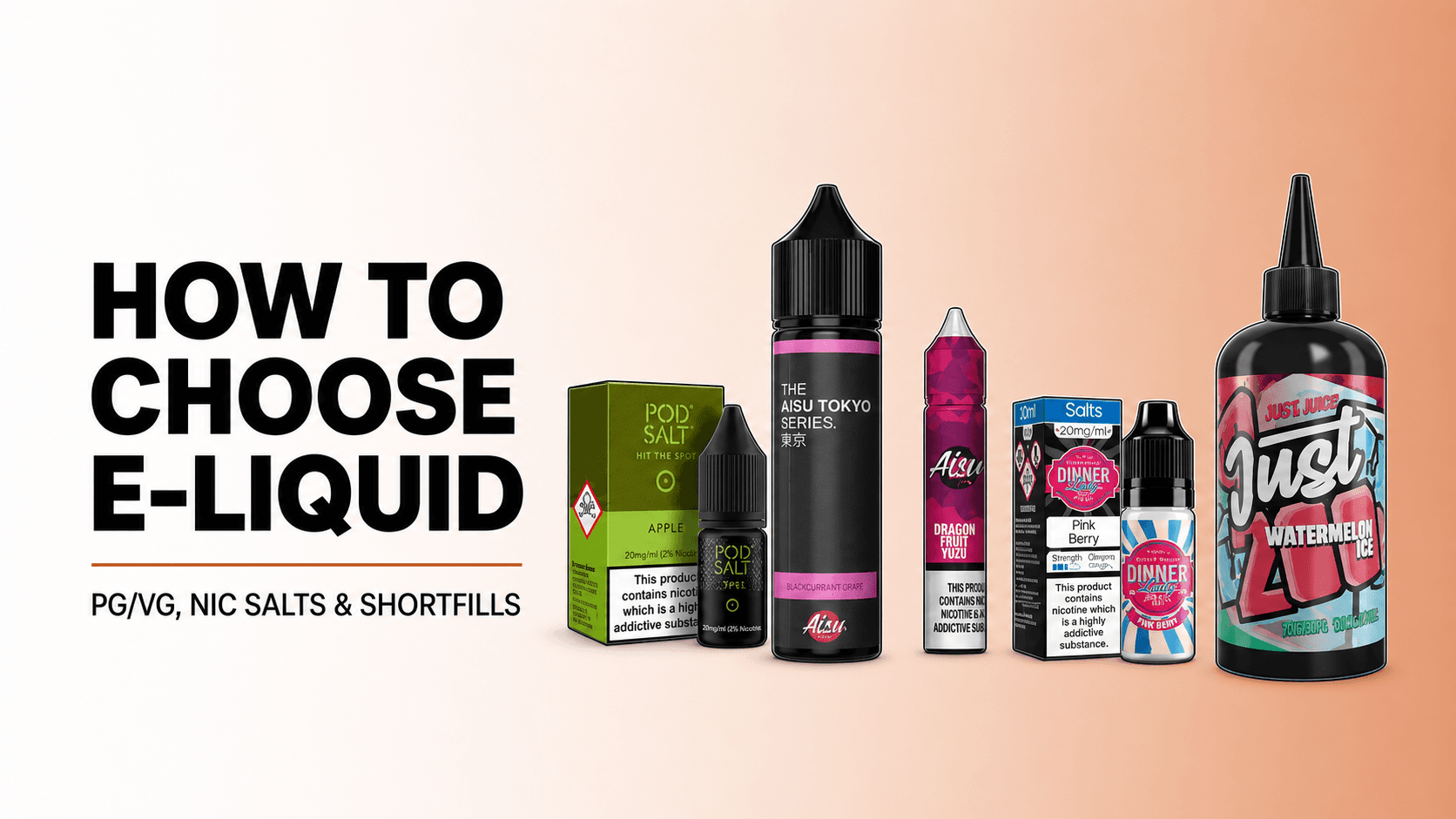
| Bottle format | Prefilled pod, 10ml refill, shortfill, longfill, or another presentation | Device compatibility by itself | Does it require filling, dilution, nicotine addition, or a closed pod? |
| Flavour description | The profile the producer intends to communicate | A guaranteed taste, safety ranking, or ingredient list | Does the full ingredient and product record meet your needs? |
Important context: Several labels can apply to the same liquid. For example, one bottle can be 50/50, salt nicotine, 10mg/ml, 10ml, and fruit flavoured.
Choose e-liquid in seven checks
Identify the exact device, pod, and coil
Use the model and resistance printed on the installed part, then open the official manual or compatibility table. Do not choose from pod kit or sub-ohm as a category alone.
Match the supported PG/VG range
Small wicking ports commonly need balanced or thinner liquid. Larger higher-output coils commonly accept thicker VG-led liquid. Follow the named product guidance when it differs from the pattern.
Choose nicotine from the smoking goal and device together
For an adult stopping smoking, assess dependence, cravings, device delivery, previous attempts, and cigarette pattern with an adviser. Do not let cigarettes per day prescribe one universal strength.
Compare salt and freebase without promises
Salt formulations are often sold at higher concentrations for low-output pods and can feel different from freebase. The actual acid, pH, device, concentration, and person matter, so try only a compatible legal product.
Choose a bottle format you can use correctly
A 10ml bottle can be ready to use. A shortfill may require an optional nicotine shot and careful mixing. A prefilled pod fits only its supported closed system. Check before opening the product.
Buy a small flavour trial where possible
Taste is personal and device-dependent. A familiar description does not guarantee that the aroma, cooling, sweetness, or throat sensation will suit you. Avoid buying a large quantity before checking compatibility and tolerance.
Check legal supply and safety details
For nicotine products, confirm the exact MHRA-published identity, nicotine concentration no higher than 20mg/ml, 10ml maximum refill presentation, warnings, seal, and child-resistant packaging. Use an accountable retailer.
Nicotine strength is one part of a delivery system
The OHID evidence review found that nicotine delivery changes with concentration, salt or freebase formulation, device type, experience, and puffing. Users can also compensate for a lower concentration by taking longer, larger, or more frequent puffs. MHRA guidance treats the device-liquid combination, power, and puff regime as relevant when nicotine delivery is measured.
This is why a 20mg/ml salt in a low-output pod and a lower-strength freebase liquid in a higher-output tank cannot be compared by concentration alone. It is also why this guide does not map 5, 10, or 20mg/ml to a fixed cigarette count. For cessation, the useful question is whether the complete setup controls withdrawal and supports zero cigarettes without persistent unwanted effects.
OHID 2022 evidence summary and MHRA dose guidanceEvidence checked 2026-08-06
Limitation: Population evidence and laboratory puff regimes cannot predict the exact dose, sensation, craving control, or side effects for one person and setup.
PG/VG ratio mainly solves a flow and output problem
Vegetable glycerine, or VG, is more viscous. Propylene glycol, or PG, is less viscous. The ratio therefore changes how readily a liquid reaches the wick and how the device aerosolises it. It can also change visible aerosol, perceived throat feel, and flavour presentation, but those sensations are influenced by the whole formulation and setup.
A small low-power pod with narrow wicking ports may struggle to replenish a very thick VG-led liquid, causing weak output or a dry, burnt draw. A large high-output coil designed for thicker liquid may flood or leak with a much thinner blend. Neither outcome proves the liquid is defective. It can be a compatibility mismatch.
Use 50/50 as a common pod pattern, not a universal command. Some compact coils support moderately VG-led liquid, and some tanks have specific restrictions. The official coil or device instruction wins. Do not add water, alcohol, oil, food flavouring, or another improvised diluent to force an incompatible liquid through a coil.
Common UK liquid formats compared
| Comparison point | Typical starting state | Main decision | Common mistake |
|---|---|---|---|
| 10ml nicotine refill | Ready-to-use legal nicotine liquid at the labelled ratio and concentration | Match formulation, concentration, and ratio to the supported setup | Assuming every 10ml salt is 50/50 or suitable for every pod |
| 10ml nicotine-free refill | Ready to use if the device supports the ratio and ingredients | Decide whether zero nicotine fits the smoking or vaping goal | Using zero nicotine during an unstable quit attempt despite uncontrolled withdrawal |
| Shortfill | Larger nicotine-free liquid bottle with unfilled space | Use at zero or add only the calculated compatible consumer nicotine shot | Assuming one shot always makes 3mg/ml regardless of strength and final volume |
| Prefilled pod or cartridge | Sealed liquid and coil combination for a named device family | Match exact device compatibility, flavour, and concentration | Opening, refilling, or adapting a closed pod not designed for it |
Important context: Format names describe packaging or use. Always read the separate ratio, nicotine formulation, concentration, and compatibility details.
Choose a format from the device and goal
If you use a low-power refillable MTL pod to stop smoking
Start with a supported balanced liquid and an adviser-led nicotine choice
A compatible viscosity protects wicking, while sufficient nicotine and support address the withdrawal problem that can return someone to cigarettes.
Watch for: Salt versus freebase and the concentration still depend on the product, device, cigarette history, and response.
If you use a supported RDL pod
Use the exact ratio and nicotine range specified for that pod
RDL platforms vary widely. The named pod and power provide better compatibility evidence than a generic 50/50 or high-VG rule.
Watch for: A change in airflow, pod, or power can change liquid consumption and nicotine delivery.
If you use a purpose-built high-output DTL tank
Choose a supported VG-led liquid and reassess nicotine concentration
Larger wicking ports and higher output commonly suit thicker liquid, while more aerosol per draw changes the nicotine decision.
Watch for: Do not assume all shortfills are compatible or that every nicotine shot produces the same final strength.
If you do not smoke and want a flavoured liquid to experiment with
Do not start vaping
The lower-risk comparison applies to an adult replacing cigarettes, not to adding inhaled aerosol and possible nicotine dependence to no use.
Watch for: Nicotine-free liquid does not make vaping harmless.
What a bad match can look like
Dry or burnt draw: stop and check liquid level, priming, power, coil age, and whether the liquid is too viscous for the wick. Do not keep inhaling a burnt taste or try to fix it with more power.
Leak, spitback, or gurgling: inspect the pod, seals, filling method, coil seating, airflow, and liquid ratio. A liquid that is too thin for a large coil can contribute, but damage and assembly faults can look similar.
Harshness or irritation: review nicotine concentration, formulation, PG/VG ratio, power, coil condition, and puffing. The cause cannot be diagnosed from one symptom online. NHS guidance lists coughing, dry mouth and throat, irritation, shortness of breath, and headaches among possible side effects. Seek appropriate advice for persistent or concerning symptoms.
Cravings continue: do not respond only by taking longer and more frequent puffs. Ask a stop-smoking adviser to review nicotine, device delivery, technique, and behavioural support. The target is a sustainable complete switch away from cigarettes.
Common e-liquid selection questions
Is 50/50 the same as nic salt?
No. 50/50 states the PG/VG ratio. Nic salt states the nicotine formulation. A salt liquid can be 50/50, and a freebase liquid can also be 50/50. Read both parts of the label.
Can I use shortfill liquid in a pod kit?
Only if the named pod supports that final PG/VG ratio and nicotine concentration. Many shortfills are too viscous for small MTL wicking ports, but some broader pod systems support VG-led liquids. Check the official coil guidance.
Are nicotine salts always smoother and faster?
No universal guarantee applies. Salt chemistry, acid, pH, concentration, device, power, and puffing affect sensation and delivery. OHID evidence suggests salt formulations can increase nicotine exposure compared with freebase in some studies, not that every salt behaves identically.
What strength should a 20-a-day smoker choose?
Cigarettes per day is useful context but not a prescription. Dependence, time to the first cigarette, device output, formulation, puffing, previous attempts, and cravings matter. Ask a stop-smoking adviser for an individual plan.
Does one nicotine shot always make a shortfill 3mg?
No. The result depends on shot concentration, shot volume, starting liquid volume, and final volume. One 10ml shot at 18mg/ml added to 50ml of zero-nicotine liquid makes 60ml at 3mg/ml. Change any number and the result changes.
Can I mix two flavours?
Mixing compatible regulated liquids changes the final ratio, nicotine concentration, and flavour. Calculate those results first and do not mix products with unclear ingredients or incompatible device requirements. Evidence about inhaled flavour combinations remains incomplete.
Does expensive e-liquid mean safer e-liquid?
No. Price does not establish safety or compliance. Check the exact product record, legal concentration and container, seal, warning, ingredient information, seller, and device compatibility. A premium flavour claim is not a safety standard.
What should I do after an unwanted reaction?
Stop using the product and seek medical advice appropriate to the symptoms. Keep the bottle and batch details if safe. Suspected side effects or product defects can be reported through the MHRA Yellow Card scheme.
Live products, prices and stock
This article explains the question or review. Use the linked shop pages for current product options, prices and availability.
Related reading
Sources and verification
- Using e-cigarettes to stop smokingNHSPublished or updated: 15 July 2026Checked: 6 August 2026
Supports: Adult-smoker scope, nicotine choice, complete switching, product types, side-effect reporting, pregnancy, and non-smoker warning.
- Vaping to quit smokingNHS Better HealthChecked: 6 August 2026
Supports: Withdrawal-led nicotine choice, common side effects, stop-smoking support, and Yellow Card reporting.
- Nicotine vaping in England: 2022 evidence update summaryOffice for Health Improvement and DisparitiesPublished or updated: 29 September 2022Checked: 6 August 2026
Supports: Nicotine-delivery variability, salt and freebase evidence, compensatory puffing, PG/VG context, flavour evidence, and research limitations.
- Chapter 4: dose of nicotine delivered and uptake and consistency of doseMedicines and Healthcare products Regulatory AgencyPublished or updated: 16 August 2024Checked: 6 August 2026
Supports: Dependence of nicotine delivery on device, power, liquid, product combination, and stated puff regime.
- E-cigarettes: regulations for consumer productsMedicines and Healthcare products Regulatory AgencyChecked: 6 August 2026
Supports: Nicotine concentration, refill-container and tank limits, packaging, ingredients, warning, and notification requirements.
- Vaping Products Duty: constituent partsHM Revenue and CustomsPublished or updated: 15 April 2026Checked: 6 August 2026
Supports: Current official descriptions of glycerine, propylene glycol, liquid nicotine, flavourings, and typical liquid composition.
- Vaping: a guide for health and social care professionalsNational Centre for Smoking Cessation and TrainingChecked: 6 August 2026
Supports: Personal device and nicotine selection, dependence assessment, sufficient nicotine for withdrawal and urges, and cessation support.
Editorial record
- Last reviewed
- 6 August 2026
- Next review due
- 10 November 2026
What changed
Separated ratio, nicotine formulation, concentration, bottle format, and flavour instead of comparing unlike categories. Removed cigarettes-per-day prescriptions, smoothness and speed guarantees, flavour claims, product picks, and the rotation rule. Added compatibility, shortfill maths, evidence limits, safety, and troubleshooting.
Disclosure
Vape Forest sells e-liquids and benefits from purchases in this category. This guide explains labels and compatibility but does not prescribe nicotine, guarantee a flavour experience, or override a device, liquid, or healthcare instruction.