The short answer
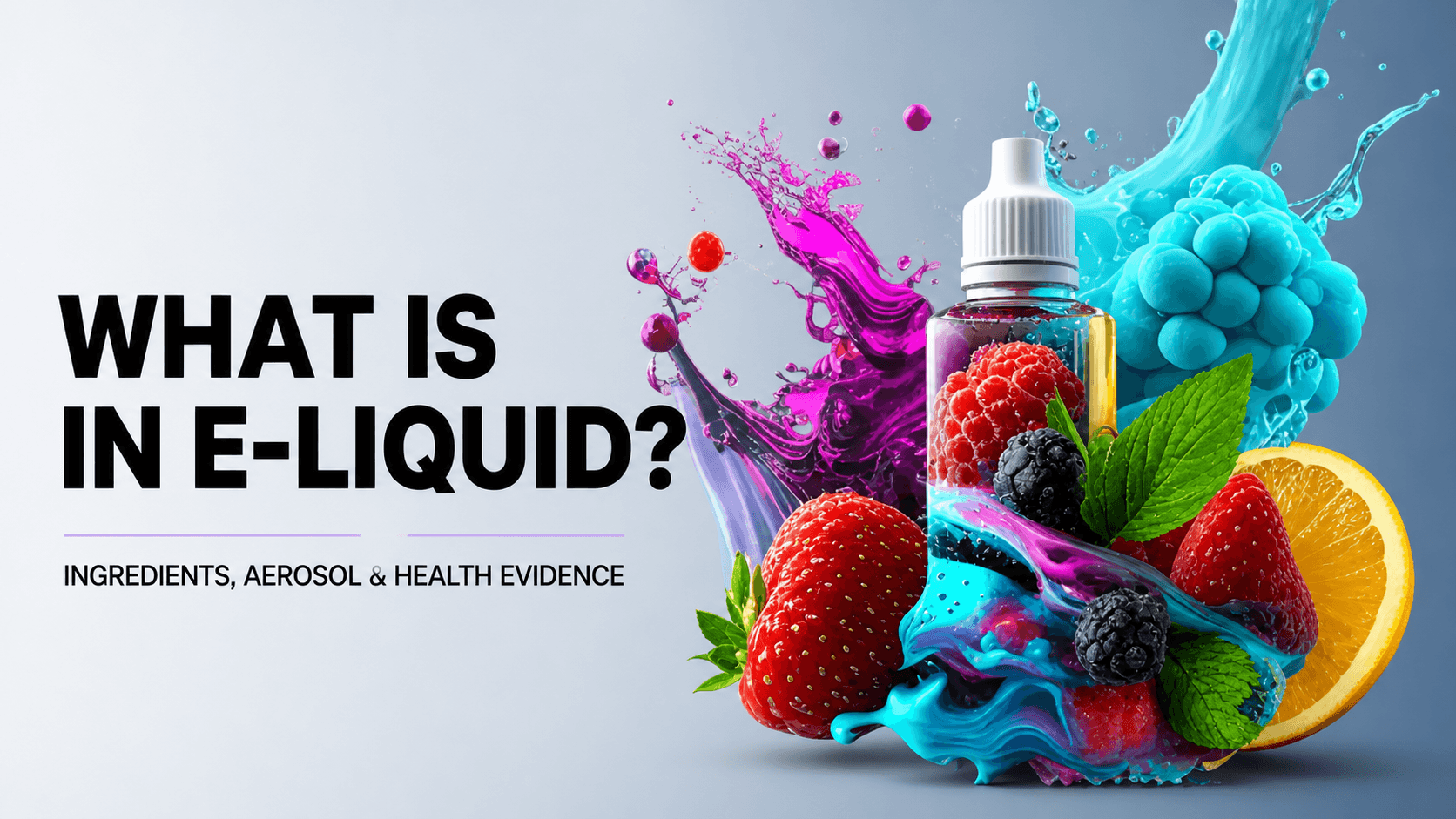
E-liquid commonly contains propylene glycol, vegetable glycerine, flavourings, and sometimes nicotine, but there is no honest four-ingredient rule. Depending on the formulation, it can also contain water, ethanol, acids used to form nicotine salts, sweeteners, cooling agents, or other permitted constituents. The ingredient list describes the liquid before use, not everything a person may inhale after a device heats it.
Heating can change ingredients and create degradation products. The coil and other device parts can also contribute particles or metals. Product, power, coil condition, liquid composition, and puffing all affect the aerosol. For an adult who smokes, switching completely to a regulated nicotine vape generally means much lower exposure to harmful substances than continuing to smoke. It does not make vaping harmless, and a person who does not smoke should not start.
Key points
- A typical ingredient list is not a universal recipe and does not describe every constituent of the heated aerosol.
- Food use and inhalation are different exposure routes; a food-approved flavour is not automatically proven safe to inhale.
- Heating conditions, device materials, liquid formulation, coil state, and puffing can all change what reaches the aerosol.
- UK notification creates market requirements for nicotine products, but it is not the same as a medicine licence or a test certificate for each retail unit.
- Complete switching exposes an adult smoker to fewer harmful substances than continued smoking, while no use is the lower-risk choice for a non-smoker.
The familiar summary of propylene glycol, vegetable glycerine, flavourings, and nicotine is useful only as a starting point. Nicotine is optional. Flavour mixtures can contain many compounds. Nicotine salt liquids usually include an acid, and a formulation may contain water, ethanol, sweeteners, or cooling agents. The exact recipe belongs to the exact product, not to e-liquid as a whole.
A second mistake is to look at the bottle and assume that its list is a complete description of exposure. A vape heats liquid into an aerosol. Heat can transform some constituents, and the device can add material of its own. This guide separates those stages and explains what UK rules establish. For choosing a compatible bottle, use the e-liquid selection guide. For the wider risk comparison, read whether vaping is worse than smoking.
Separate the liquid, aerosol, and exposure
| Comparison point | What it means | What can change it | What it cannot prove |
|---|---|---|---|
| Liquid composition | Ingredients and concentrations in the bottle, pod, or reservoir before use | Product recipe, storage, age, mixing, and contamination | Every compound in the aerosol or the dose absorbed by a person |
| Aerosol composition | Droplets, gases, particles, and compounds emitted after heating | Power, temperature, airflow, coil condition, device materials, liquid, and puff pattern | The exact amount retained or absorbed by one user |
| Personal exposure | What reaches and may be taken up by a particular person | Frequency, draw size, technique, device output, environment, and biology | A guaranteed long-term health outcome from one ingredient list |
Important context: These stages are connected but not interchangeable. A laboratory result is meaningful only with its tested product, device, operating conditions, and measurement method.
PG and VG carry the formulation, but they are not the whole story
Propylene glycol, or PG, is a relatively low-viscosity carrier. Vegetable glycerine, or VG, is more viscous and is also called glycerol. Their ratio affects liquid flow, wicking, aerosol production, and sensory qualities. A balanced liquid commonly suits a small pod, while a VG-led liquid commonly suits larger wicking ports and higher output. Device guidance matters more than a general rule.
Water or ethanol can be present to adjust formulation properties. Nicotine salt liquids normally combine nicotine with an acid, but salt is a broad formulation category rather than one chemical recipe. Flavour concentrates can include multiple aromatic compounds, and producers may also use sweetening or cooling constituents. UK consumer rules ban certain ingredients in nicotine products, including colourings, caffeine, and taurine, but the absence of those ingredients does not turn the remainder into an inhalation guarantee.
The useful question is therefore not how many ingredients all vapes have. It is what the exact product contains, whether that product is legally supplied, how it is used, and what the evidence can show about the resulting aerosol and exposure.
Flavour evidence is specific, incomplete, and easy to overstate
The OHID evidence review found limited evidence from cell and animal studies that some flavourings, particularly cinnamaldehyde and some buttery or creamy profiles, may alter cellular responses. PG/VG-only base liquids appeared to have little or no effect in those included models. Those results did not establish that all flavouring is equally harmful, that every product in a named flavour category contains the same compounds, or that unflavoured liquid is risk-free.
The studies varied in liquid composition, cell type, dose, exposure duration, controls, and whether they tested liquid, aerosol extract, or aerosol. The review called for more standardised assessment and more research into thermal degradation, mixtures, and stability. That is a reason to preserve uncertainty, not to replace it with either reassurance or alarm.
OHID 2022 evidence update, flavour chapterEvidence checked 2026-08-06
Limitation: Laboratory findings do not directly predict the long-term risk of a particular flavour, device, dose, or person. Product recipes can also change.
Nicotine creates dependence, but smoke creates most smoking harm
Nicotine is optional in e-liquid. When present, the label concentration in mg/ml describes the amount in each millilitre of liquid, not the amount absorbed from one draw. Delivery varies with formulation, device, power, puffing, experience, and how often the product is used. Read the nicotine content guide before comparing labels.
Nicotine is addictive and can be harmful in high doses. It is not, however, the main source of the cancer, lung, and cardiovascular burden caused by smoking. Cigarettes burn tobacco and produce a complex smoke containing tar, carbon monoxide, and many toxic chemicals. Vapes do not burn tobacco, which is central to their lower-risk role for adults who would otherwise smoke.
This distinction must not become an endorsement for new use. Children, young people, and people who do not smoke should not vape. During pregnancy, the NHS recommends licensed nicotine replacement products and advice from a GP. Liquid nicotine must be kept away from children and pets, and spills should be handled using the product instructions.
The aerosol is produced by both the liquid and the device
Heating does not simply lift an unchanged liquid into the air. Some liquid becomes aerosol droplets, while heat can also break down or transform constituents. MHRA guidance for products seeking a medicine licence identifies acrolein, formaldehyde, and acetaldehyde as carbonyls that can form through thermal decomposition of glycerol or propylene glycol under some conditions. It also calls for examination of particles and metals that can come from heating elements, solder, adhesives, plastics, and other components.
That medicine-licensing guidance sets a higher evidence pathway than ordinary consumer notification. It is useful here because it shows the chemical questions a rigorous product assessment must ask. It does not mean that every consumer product produces the same compounds at the same level or has completed medicinal testing.
Power, temperature control, airflow, liquid supply to the wick, coil age, deposits, and draw pattern can change emissions. A dry or burnt draw signals a problem, not a normal flavour to push through. Stop, let the device cool, check liquid level and compatibility, replace a spent pod or coil, and follow the manufacturer instructions. Do not modify power beyond the supported range or improvise liquid ingredients.
What UK nicotine-product notification does and does not establish
| Comparison point | Required for legal supply | Useful conclusion | Conclusion not justified |
|---|---|---|---|
| Published notification | The product identity must be notified and published before sale | Match the exact brand, product, flavour, and strength to the relevant record | MHRA tested or medically approved every shop unit |
| Presentation limits | Maximum 20mg/ml nicotine, 10ml refill container, and 2ml tank or cartridge | A visibly conflicting nicotine presentation should not be bought or sold | A product within those limits is automatically authentic or harmless |
| Ingredients and packaging | Specified ingredient restrictions, warnings, child resistance, and tamper evidence | Check the seal, warning, ingredients, batch details, and responsible supplier | Food-approved ingredients have all been proven safe for lifelong inhalation |
Important context: MHRA states that its role for consumer vapes is regulatory compliance, not approval of the products as medicines. Counterfeit and illicit units can also copy a legitimate identity.
Use the evidence according to your situation
If you smoke and are considering vaping to quit
Use a regulated product to replace cigarettes completely, with stop-smoking support
The strongest practical benefit comes from avoiding combustion and moving to zero cigarettes, while choosing a product and nicotine level that control withdrawal.
Watch for: Vaping is not risk-free, and dual use continues cigarette-smoke exposure. A local stop-smoking service can help with product choice and a complete switch.
If you do not smoke
Do not start vaping
The lower-risk comparison is relative to continued smoking. Starting from no smoking or vaping adds aerosol exposure and, with nicotine, dependence.
Watch for: Nicotine-free does not mean exposure-free or proven harmless.
If a particular liquid causes persistent irritation, nausea, dizziness, breathing symptoms, or another unwanted effect
Stop using it and seek healthcare appropriate to the symptoms
A general ingredient article cannot identify the cause or judge an individual symptom. Product, nicotine, technique, contamination, and unrelated illness can overlap.
Watch for: Use 999 for an emergency. Keep the product and batch details if safe, and report a suspected side effect or defect through MHRA Yellow Card.
If the product identity, ingredients, seal, nicotine presentation, or seller appears suspicious
Pause use and verify the exact product before deciding what it contains
A label is evidence only if it belongs to the genuine unit. Compare the MHRA record, manufacturer verification, packaging, batch details, and accountable seller.
Watch for: A published identity does not authenticate one physical unit. Use the <a href="/vape-guide/health/stop-buying-fake-vapes/">fake-vape checking guide</a> and report suspected illegal supply.
Common questions about e-liquid ingredients
Does every e-liquid have four ingredients?
No. PG, VG, flavouring, and nicotine describe a common pattern, not a universal recipe. Nicotine and flavouring can be absent, while water, ethanol, acids, sweeteners, cooling agents, or other constituents can be present. Read the exact product information.
Is vape aerosol just water vapour?
No. A vape produces an aerosol containing suspended droplets and other constituents. It is not cigarette smoke because there is no tobacco combustion, but water vapour is not an adequate description of what is inhaled.
Are PG and VG safe to inhale?
No blanket harmlessness claim is justified. They are common carrier ingredients, and the OHID review found much lower harmful exposure from vaping than smoking overall. Evidence about long-term vaping remains incomplete, and heating conditions can create degradation products.
Are natural flavourings safer than artificial flavourings?
The words natural and artificial do not provide an inhalation-risk ranking. Risk depends on the compound, concentration, mixture, heating behaviour, aerosol, exposure, and evidence. Natural origin is not a toxicology test.
Does an MHRA listing mean the liquid was approved?
It means a matching consumer product notification was published, which is required before legal sale. MHRA distinguishes this compliance role from medicinal licensing. The listing is not a medicine approval, a guarantee of zero risk, or proof that a physical unit is genuine.
Is nicotine the dangerous part of smoking?
Nicotine causes dependence and can be harmful in high doses, but the NHS states that most smoking harm comes from the many other chemicals in tobacco smoke. Avoiding combustion explains why complete switching can reduce exposure compared with continued smoking.
Can a label tell me exactly what I inhale?
No. It describes the supplied product, not every heated emission or the dose absorbed by you. Device materials, power, coil condition, airflow, and puffing also affect the aerosol. Product-specific laboratory analysis would need to state the tested conditions.
What should I do if e-liquid is swallowed or gets in the eyes?
Follow the product safety instructions and seek urgent professional advice appropriate to the exposure. Do not rely on an online ingredient article to assess a possible poisoning. Use 999 for severe or life-threatening symptoms and keep the container available for responders if safe.
Live products, prices and stock
This article explains the question or review. Use the linked shop pages for current product options, prices and availability.
Related reading
Sources and verification
- Using e-cigarettes to stop smokingNHSPublished or updated: 15 July 2026Checked: 6 August 2026
Supports: Typical e-liquid constituents, aerosol terminology, smoking comparison, nicotine context, non-smoker advice, long-term uncertainty, and Yellow Card reporting.
- Nicotine vaping in England: 2022 evidence update summaryOffice for Health Improvement and DisparitiesPublished or updated: 29 September 2022Checked: 6 August 2026
Supports: Relative and absolute exposure, flavour toxicology findings and limitations, thermal degradation questions, nicotine, metals, and evidence gaps.
- Advice on ingredients in nicotine-containing e-liquidsMedicines and Healthcare products Regulatory AgencyPublished or updated: 16 August 2024Checked: 6 August 2026
Supports: Ingredient and emissions safety responsibilities, toxicology requirements, prohibited substances, and why food-use status does not establish safe use in an e-cigarette.
- E-cigarettes: regulations for consumer productsMedicines and Healthcare products Regulatory AgencyPublished or updated: 16 August 2024Checked: 6 August 2026
Supports: Nicotine concentration and container limits, banned ingredients, packaging, warnings, and notification requirements.
- Guidance for licensing electronic cigarettes as medicinesMedicines and Healthcare products Regulatory AgencyPublished or updated: 3 November 2022Checked: 6 August 2026
Supports: Thermal decomposition, carbonyls, metal and particle contribution, and the distinction between consumer notification and medicinal authorisation.
- E-cigarettes and harm reduction: An evidence reviewRoyal College of PhysiciansPublished or updated: 18 April 2024Checked: 6 August 2026
Supports: Independent evidence review on smoking harm reduction, health effects, and discouraging uptake among young people and never-smokers.
- Vaping Products Duty: constituent partsHM Revenue and CustomsPublished or updated: 15 April 2026Checked: 6 August 2026
Supports: Current official descriptions of propylene glycol, glycerine, liquid nicotine, flavourings, and common liquid composition.
- Advice for consumersMedicines and Healthcare products Regulatory AgencyPublished or updated: 18 June 2026Checked: 6 August 2026
Supports: Current consumer advice, published nicotine-product checks, and suspected side-effect reporting through Yellow Card.
Editorial record
- Last reviewed
- 6 August 2026
- Next review due
- 10 November 2026
What changed
Replaced the false four-ingredient formula and food-grade safety implication with a sourced distinction between liquid composition, heated aerosol, and exposure. Added evidence limits for flavourings and PG/VG, nicotine context, thermal degradation, device contributions, UK notification boundaries, and symptom reporting.
Disclosure
Vape Forest sells e-liquids and benefits from purchases in this category. This article explains current ingredient, exposure, and regulatory evidence. It does not certify a product, provide a chemical analysis of a retail unit, or replace medical advice.