The short answer
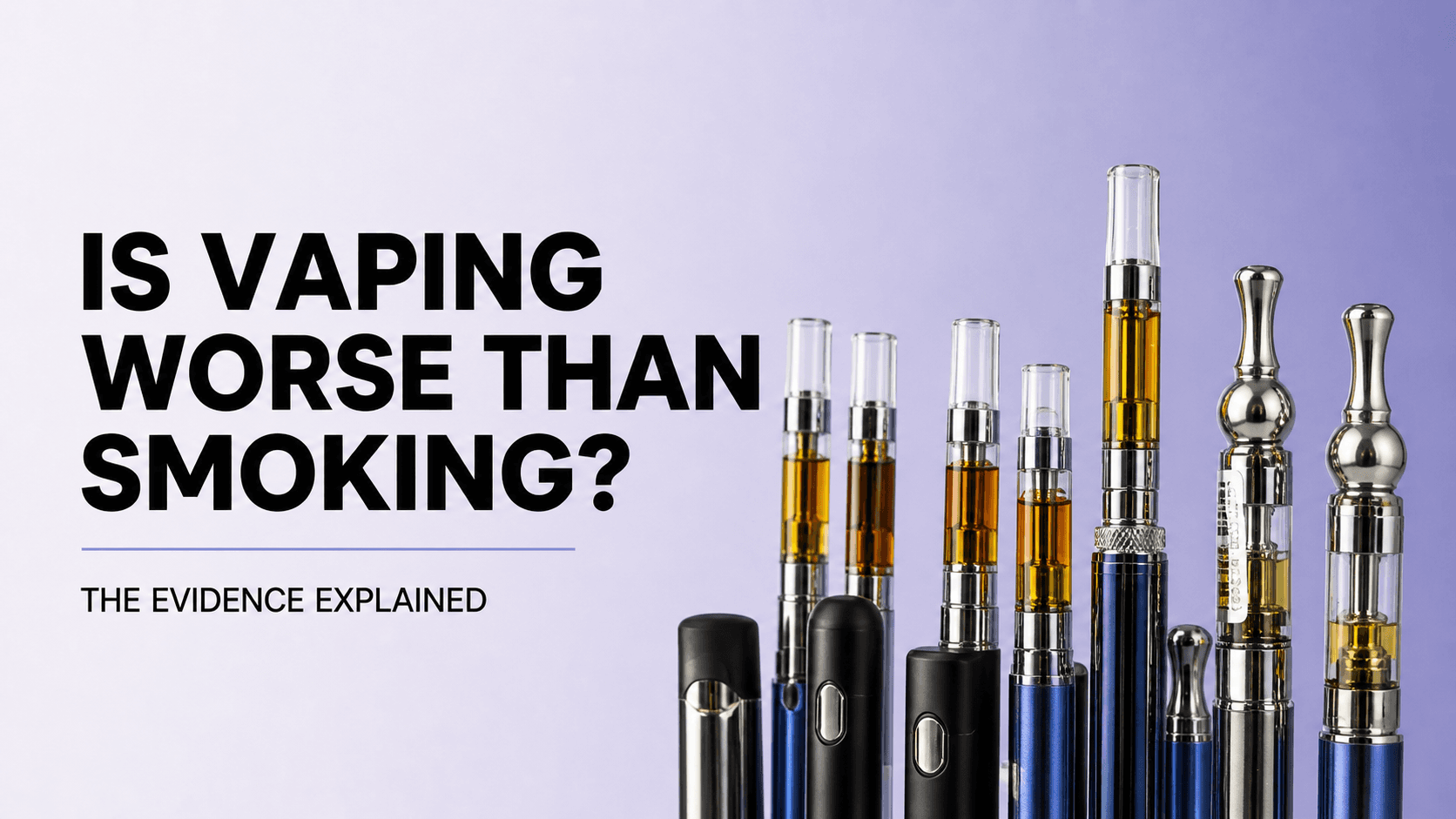
For an adult who already smokes, regulated nicotine vaping is less harmful than continuing to smoke. It is not worse than smoking and it is not harmless. The central difference is combustion. Cigarettes burn tobacco and create smoke containing tar, carbon monoxide, and many toxic chemicals. A vape heats liquid without burning tobacco, so exposure to many harmful substances is substantially lower.
That comparison does not make vaping healthy for a non-smoker. If you do not smoke, the lower-risk choice is not to vape. If you smoke and use vaping to reduce harm, the meaningful health target is a complete switch away from cigarettes. Continuing to smoke alongside vaping preserves exposure to tobacco smoke, and the long-term risks of vaping are still not fully known.
Key points
- Smoking is more harmful because burning tobacco creates smoke with tar, carbon monoxide, and many toxic substances.
- Vaping exposes users to fewer harmful substances at lower levels, but lower exposure does not mean zero risk.
- Nicotine drives dependence, while most smoking-related disease comes from other chemicals in tobacco smoke.
- The long-term health effects of vaping remain less certain than the well-established harms of smoking.
- Complete switching matters; smoking and vaping together still exposes the user to cigarette smoke.
The question sounds binary, but the useful answer depends on the comparison group. An adult who continues smoking, an adult who switches completely to vaping, a person who both smokes and vapes, and a person who has never smoked do not share the same starting risk.
This guide compares regulated nicotine vaping with combustible cigarettes. It does not cover cannabis or THC products, illicit liquids, heated-tobacco products, or medical inhalers. If the comparison is part of a quit attempt, use the practical stop-smoking plan. For nicotine dose questions, read why cigarettes and vapes do not convert neatly. For ingredients, see the e-liquid ingredient evidence guide.
Smoking and vaping: the comparison that matters
| Comparison point | Cigarette smoking | Regulated nicotine vaping | What can be concluded |
|---|---|---|---|
| Process | Burns tobacco and creates smoke | Heats e-liquid and creates an aerosol | Removing combustion removes the main source of smoking harm |
| Tar and carbon monoxide from tobacco smoke | Present as products of smoking | Not produced by burning tobacco because no tobacco is burned | This is a major reason vaping is less harmful than smoking |
| Toxicant exposure | High exposure to many established toxic substances | Lower exposure to many harmful substances, but not zero | Biomarker evidence supports lower exposure after switching |
| Nicotine | Usually present and highly dependence-forming | Often present and dependence-forming | Nicotine is not the main cause of smoking-related cancer and lung disease |
| Long-term evidence | Decades of evidence establish severe disease and mortality risks | Long-term risks are still being studied | Uncertainty about vaping does not erase the known difference from smoking |
Important context: This is a population-level evidence comparison, not an individual diagnosis or a claim that every product has the same emissions. Product, power, liquid, use pattern, and smoking history can affect exposure.
Why lower exposure is a stronger claim than a catchy percentage
The Office for Health Improvement and Disparities reviewed biomarkers linked with cancer, respiratory disease, and cardiovascular disease. Its 2022 update reported significantly lower exposure to harmful substances from vaping compared with smoking. The findings support the conclusion that short-term and medium-term vaping risk is a small fraction of smoking risk.
This article does not convert that conclusion into an exact personal percentage. Different diseases, products, behaviours, and time horizons do not reduce to one precise number, and long-term outcome data remain incomplete.
OHID nicotine vaping evidence updateEvidence checked 2026-08-06
Limitation: Biomarkers show exposure and biological signals, not a complete lifetime disease forecast. Some evidence is short-term, and product designs continue to change.
Nicotine and smoke are different parts of the problem
Nicotine makes cigarettes and many vapes dependence-forming. It can keep a person using the product and can be harmful at high doses. That deserves honest treatment. It is still not accurate to blame nicotine for most of the cancer, lung disease, and cardiovascular damage caused by smoking.
The NHS explains that most smoking harm comes from the thousands of other chemicals in tobacco smoke, many of which are toxic. This is why licensed nicotine replacement therapy has long been used in stop-smoking treatment and why replacing smoke exposure can reduce harm even when nicotine use continues for a time.
Nicotine delivery varies between cigarettes, liquids, pods, devices, and users. A 2ml pod is not medically equivalent to a packet of cigarettes. Pack strength, device output, puff length, inhaling pattern, and unused liquid all change the comparison. Treat a puff or volume conversion as an estimate with declared assumptions, never as a clinical dose rule.
What not risk-free means in practice
Dependence: nicotine can sustain dependence, and some products make frequent use easy. An adult who has never smoked gains no harm-reduction benefit by starting.
Aerosol exposure: vaping aerosol is not clean air or harmless water vapour. It can contain nicotine, flavouring products, small particles, and other potentially harmful substances. The mixture and level depend on the product and how it is operated.
Short-term effects: research reports non-serious effects such as throat or mouth irritation, cough, headache, and nausea. A symptom or suspected adverse reaction should not be diagnosed from an article. Seek appropriate medical advice and use the MHRA Yellow Card route to report a suspected reaction or product concern.
Long-term uncertainty: smoking has a much longer outcome record. Vaping has not existed for enough decades to measure every lifetime risk directly, and newer devices continue to change. The defensible conclusion is lower risk than smoking, not no future harm.
Product and battery safety: use regulated UK products, follow power and charging instructions, keep liquid away from children and pets, and never use damaged batteries or improvised liquid ingredients.
What the comparison means for different readers
If you currently smoke and can stop without vaping
Use the stop-smoking route that you can sustain
Stopping cigarettes is the health objective. NHS support, nicotine replacement, and stop-smoking medicines can be considered without taking up vaping.
Watch for: Treatment suitability and combinations should be discussed with a qualified professional.
If you currently smoke and vaping is the acceptable alternative
Use it as a route to stop cigarettes completely
Switching removes continued exposure to tobacco smoke while the vape manages nicotine and aspects of the routine.
Watch for: Vaping remains a nicotine product with its own risks and uncertainties.
If you both smoke and vape
Treat dual use as a transition, not the destination
Even a reduced number of cigarettes maintains smoke exposure. Review craving control, triggers, device reliability, and support to move towards zero cigarettes.
Watch for: Do not assume that halving cigarettes automatically halves every health risk.
If you do not smoke
Do not start vaping for health reasons
The harm-reduction comparison only exists against continued smoking. Compared with using neither product, vaping adds exposure and possible nicotine dependence.
Watch for: Young people and children must not vape, and nicotine products are age-restricted.
Why complete switching changes the answer
Relative risk is useful only if behaviour changes. Buying a vape while continuing the same smoking pattern does not remove tobacco smoke. The NHS states that a person does not get the full benefit from vaping unless cigarettes stop completely.
That does not mean a difficult transition should be treated as failure. It means the plan needs a clear destination and enough support. Persistent dual use can signal inadequate nicotine delivery, an unsuitable device, missing routines, social triggers, or a treatment plan that needs review. The solution is to investigate those barriers with a stop-smoking adviser rather than to declare that vaping and smoking are equivalent.
Once smoking has stopped, do not rush a nicotine reduction if that makes relapse more likely. The immediate health priority is preserving the smoke-free outcome. Later reduction can be planned separately.
Common questions about relative harm
Is vaping worse than smoking for your lungs?
UK evidence reviews conclude that regulated vaping is substantially less harmful than smoking because it avoids tobacco combustion and lowers exposure to many toxic substances. Vaping can still irritate the respiratory tract, and its full long-term effects are not yet known.
Is vaping safe if it has no nicotine?
Removing nicotine removes nicotine exposure and dependence from that liquid, but it does not turn aerosol into clean air. Other ingredients, particles, device operation, and product quality still matter. A non-smoker gains no health benefit by starting.
Is nicotine what causes lung cancer from smoking?
Nicotine causes dependence, but the NHS says most smoking harm comes from the thousands of other chemicals in tobacco smoke. Burning tobacco, not nicotine alone, is central to the cancer and lung-disease risk from cigarettes.
Is a 20mg 2ml vape equal to 20 cigarettes?
No fixed medical equivalence exists. Liquid concentration and volume describe what is in the product, not exactly what one person absorbs. Device efficiency, puff length, frequency, inhaling pattern, cigarette type, and leftover liquid change the comparison.
Is dual use almost as good as switching?
No. Smoking fewer cigarettes may change exposure, but continued smoking preserves the central source of harm. Do not assume risk falls in direct proportion to cigarette count. Use support to make complete switching the goal.
Why not say vaping is exactly 95% safer?
A single number can hide differences between diseases, products, behaviours, and time horizons. Current UK evidence supports the conclusion that vaping poses a small fraction of smoking risk in the short and medium term. This guide keeps that conclusion without pretending to calculate an exact personal lifetime percentage.
Related reading
Sources and verification
- Using e-cigarettes to stop smokingNHSPublished or updated: 15 July 2026Checked: 6 August 2026
Supports: Relative harm, absence of tobacco combustion, long-term uncertainty, adult-smoker scope, complete switching, pregnancy, and product safety.
- Nicotine vaping in England: 2022 evidence update main findingsOffice for Health Improvement and DisparitiesPublished or updated: 29 September 2022Checked: 6 August 2026
Supports: Systematic evidence review on biomarkers, toxicant exposure, relative short-term and medium-term risk, nicotine, and evidence gaps.
- E-cigarettes and harm reduction: an evidence reviewRoyal College of PhysiciansPublished or updated: 18 April 2024Checked: 6 August 2026
Supports: Independent review of health differences among people who smoke, vape, or use neither, alongside cessation and youth-use considerations.
- Electronic cigarettes for smoking cessationCochranePublished or updated: 10 November 2025Checked: 6 August 2026
Supports: Living review evidence on cessation, reported adverse effects, serious-event uncertainty, and the need for longer and larger safety studies.
- E-cigarette use or vaping: report safety concernsMedicines and Healthcare products Regulatory AgencyChecked: 6 August 2026
Supports: Current route for reporting suspected adverse reactions and product safety concerns involving e-cigarettes.
Editorial record
- Last reviewed
- 6 August 2026
- Next review due
- 10 November 2026
What changed
Removed false ingredient simplicity, cigarette-to-pod nicotine equivalence, exact risk shorthand, and unsupported recovery claims. Added combustion, biomarker evidence, uncertainty, dual-use limits, and audience-specific decisions.
Disclosure
Vape Forest sells vaping products. This comparison is intended for adult smokers considering harm reduction and does not claim that vaping is safe, prescribe treatment, or provide an individual medical risk estimate.