The short answer
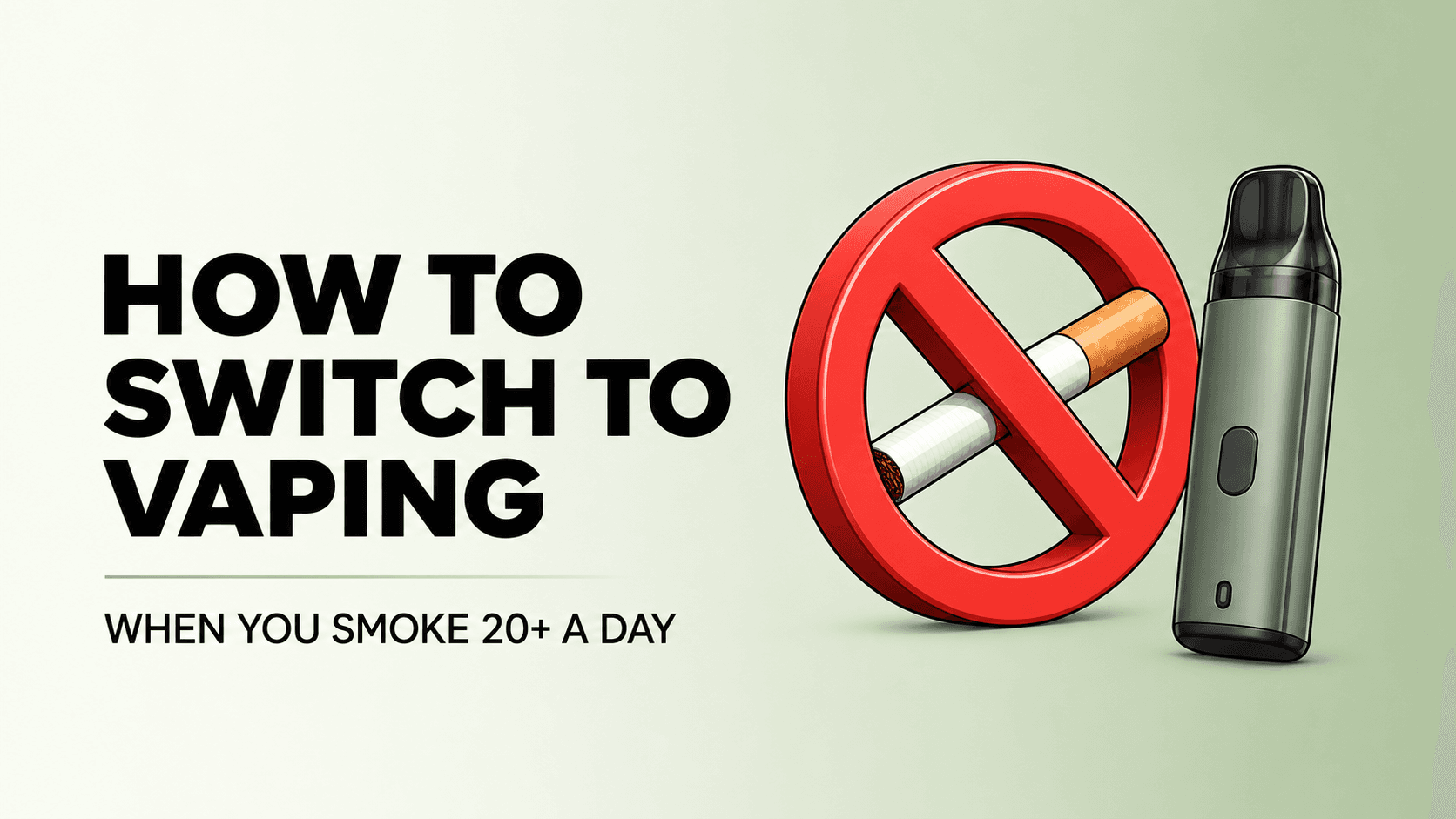
If you smoke 20 or more cigarettes a day and want to use vaping to quit, do not choose a nicotine strength or device from cigarette count alone. Start with a local Stop Smoking Service, assess when and why you smoke, choose a simple reusable device that can deliver enough nicotine for your needs, and prepare it before a firm switch date. Use it as often as needed to control withdrawal, then review persistent cravings or side effects instead of treating either as something to endure.
The target is zero cigarettes because the NHS says the full benefit of switching is not achieved while smoking continues. Some people switch immediately and others need longer. A partial switch can be a stage in the plan, not proof of failure, but it should trigger a review of nicotine delivery, technique, equipment, triggers, and support. Vaping is not risk-free, is intended here only for adults who smoke, and is one of several evidence-based options.
Key points
- Twenty cigarettes a day is one clue about dependence, not an automatic instruction to use 20mg e-liquid.
- Time to the first cigarette, overnight smoking, previous withdrawal, device delivery, and puffing behaviour also matter.
- Choose a reliable, simple setup and adequate craving control before attempting to reduce nicotine.
- Aim for zero cigarettes, but treat partial switching or a lapse as information for adjusting the plan.
- Free Stop Smoking Service support and non-vaping treatments should be considered before a retailer recommendation.
“Heavy smoker” is a loose label, not a diagnosis. Twenty cigarettes a day describes quantity, but it does not show how quickly nicotine is needed after waking, whether smoking happens overnight, how severe previous withdrawal was, or which situations make a cigarette feel non-negotiable. Those details can matter as much as the daily total.
This is why a list of seven supposedly best kits is the wrong answer. A device cannot be judged as suitable for an individual without considering dependence, delivery, usability, and support. The useful outcome is a plan that survives the first morning, the first stressful interruption, and the first equipment problem. For the broader process, see our complete guide to stopping smoking with vaping. This page concentrates on the extra preparation useful when daily smoking and withdrawal are substantial.
Build a dependence picture before choosing nicotine
| Comparison point | Question to record | What it may reveal | How it changes the plan |
|---|---|---|---|
| How soon after waking is the first cigarette? | A strong early urge can be an important sign of tobacco dependence | Prepare overnight, keep the agreed support ready, and plan the first hour precisely | |
| Do you wake to smoke or smoke when ill? | The urge may persist outside ordinary daytime routines | Discuss stronger or steadier craving support with an adviser rather than relying on willpower | |
| Which cigarettes feel hardest to remove? | Morning, driving, meals, alcohol, work breaks, or stress may have separate triggers | Give each trigger a replacement action and make the device or treatment available before it | |
| What happened in earlier quit attempts? | Breakthrough cravings, side effects, complexity, and social triggers require different fixes | Keep what worked and redesign the exact failure point with professional support | |
| What can you operate reliably? | Dexterity, eyesight, charging access, filling, and routine affect real-world use | Prefer dependable daily use and easy replacement over advanced controls |
Important context: This is preparation for a conversation with a stop-smoking adviser, not a self-diagnosis or nicotine prescription. Cigarette type and inhaling pattern also make a simple cigarette-to-milligram conversion unreliable.
Nicotine vapes can improve quit rates, but they do not select themselves
The 2025 Cochrane living review found high-certainty evidence that nicotine e-cigarettes increased six-month quit rates compared with nicotine replacement therapy in the included studies. Its plain-language estimate was 8 to 11 people stopping per 100 with nicotine e-cigarettes, compared with about 6 per 100 using nicotine replacement therapy.
That is a group-level comparison, not a guarantee and not evidence that one retail product is best for a person who smokes 20 cigarettes a day. The review also says more evidence is needed about newer products and longer-term unwanted effects. The NHS therefore presents vaping as an effective option that is less harmful than smoking, but not risk-free.
Cochrane living review, evidence searched to 1 March 2025Evidence checked 2026-08-06
Limitation: Trial averages do not determine an individual nicotine strength, device, liquid, or treatment combination. Product technology, participant support, and study methods vary.
A seven-day plan for the switch
Day 1: contact support and record the baseline
Use the NHS service finder to contact a free local Stop Smoking Service. Record cigarette count, time to the first cigarette, overnight smoking, strongest triggers, previous withdrawal, current medicines, pregnancy, and relevant health concerns.
Day 2: choose the treatment route
Discuss nicotine vaping, licensed nicotine replacement, nicotine-free medicines, behavioural support, or a suitable combination. Do not start, stop, or combine prescribed treatment from a retail article.
Day 3: make the setup usable
If vaping is chosen, use a regulated reusable device you can fill or replace, charge, and operate confidently. Check the exact pod, coil, liquid, and charging instructions. Learn the difference between <a href="/vape-guide/vape/understanding-the-differences-between-mtl-and-dtl-vaping/">mouth-to-lung and direct-to-lung use</a> without treating one resistance as mandatory.
Day 4: practise before the switch date
Use the device with guidance while cigarettes are still available so filling, activation, inhaling, and charging are familiar. Note whether cravings remain strong or the experience is uncomfortable, then adjust with support.
Day 5: remove predictable failure points
Prepare compatible spares, a charging routine, and enough supplies. Remove cigarettes, ashtrays, and automatic purchase prompts where practical. Tell supportive people what the switch date means and plan for alcohol, driving, meals, and work breaks.
Day 6: switch completely
Use the vape as often as needed for cravings and follow any professional treatment plan. Vaping can look more frequent than smoking because it is used differently. Do not count puffs as if they were cigarettes or ration an agreed quit aid until withdrawal breaks through.
Day 7: review the evidence from your own week
Count cigarettes, not puffs. Review cravings, withdrawal, side effects, device failures, and triggers with the adviser. Protect the smoke-free outcome before trying to reduce nicotine. If a cigarette happened, identify why and resume the plan rather than declaring the attempt over.
Choose support by the barrier, not by a product award
If you want the smoking ritual as well as craving relief
Discuss a simple reusable nicotine vape
It can replace parts of the hand-to-mouth, inhaling, and break routine while delivering nicotine without burning tobacco.
Watch for: Delivery varies by device, liquid, experience, and puffing, so the strength and setup may need review.
If cravings are present throughout the day
Ask about steady and fast-acting nicotine support
The NHS explains that a patch can provide ongoing nicotine and a vape can address immediate cravings. Licensed NRT also offers non-vaping combinations.
Watch for: Get professional advice on an appropriate combination, especially with pregnancy, health conditions, or medicines.
If you do not want to inhale an aerosol
Discuss licensed NRT or nicotine-free medicine
Patches, gum, lozenges, sprays, and other NRT formats manage withdrawal without vaping. Varenicline, cytisine, and bupropion are current medicine options to discuss with a service or GP.
Watch for: Availability and medical suitability differ. A clinician or qualified stop-smoking professional should check them.
If you have tried several routes and returned to smoking
Request a supported plan review
A review can separate inadequate withdrawal control from device problems, side effects, routines, stress, access, or medicine suitability.
Watch for: Repeating the same unsupported setup is unlikely to resolve an unidentified barrier.
Troubleshoot the first week without guessing
| Comparison point | What may be happening | What to check | Next step |
|---|---|---|---|
| Strong cravings or repeated cigarettes | Use frequency, nicotine strength, device delivery, inhaling technique, empty pod, worn coil, and trigger timing | Use the vape as needed and ask the adviser whether delivery or the wider treatment plan needs adjustment | |
| Cough, dry mouth, throat irritation, or headache | Liquid compatibility, device settings, inhaling pattern, hydration, and whether symptoms began with the change | Pause and seek advice from a stop-smoking adviser, healthcare professional, or responsible specialist before abandoning the quit plan | |
| Nausea, dizziness, or feeling unwell after nicotine | Frequency, concentration, combined nicotine sources, accidental liquid exposure, and other possible causes | Stop or slow nicotine use and obtain appropriate health advice. Seek urgent help for severe symptoms or suspected poisoning | |
| Burnt taste, leaking, or no aerosol | Liquid level, filling time, pod seating, coil age, power, airflow, and exact compatibility | Stop using the faulty setup, follow its instructions, and replace only with compatible parts | |
| One cigarette becomes several | The first trigger, unavailable support, and the thought that the attempt was already lost | Remove the remaining cigarettes, restore the plan, and contact support to prevent the same chain recurring |
Important context: Do not use a symptom table to diagnose yourself. Call 999 for a life-threatening emergency. Contact NHS 111 when you need urgent help and are unsure what to do.
Complete switching is the goal, while partial switching is data
Any smoking is harmful. The NHS says the full benefit of vaping is reached only when cigarettes stop completely. That should remain the destination even if the route takes longer than a day.
NICE guidance also recognises that a nicotine e-cigarette can be used as a complete or partial substitute for smoking and can be used short term or long term. Those points are not contradictory. Partial substitution may be a practical stage, especially while a person learns the device or adjusts support, but it should not quietly become the final plan.
If cigarettes remain after the first week, ask which ones remain and why. A cigarette immediately after waking suggests a different barrier from one smoked only when drinking with friends. Adjust the unmet need, keep the reduction already achieved, and continue towards zero. For nicotine comparisons, read why a vape cannot be converted neatly into a number of cigarettes.
Questions from people who smoke 20 or more a day
Should a 20-a-day smoker automatically start at 20mg?
No. Twenty cigarettes a day can suggest substantial dependence, but it does not determine a concentration by itself. Time to the first cigarette, previous withdrawal, the chosen device, liquid formulation, user experience, and puffing behaviour all affect delivery. Use professional support to choose and review an adequate starting plan.
Is a 1.0 or 1.2 ohm coil always best for quitting?
No. Resistance is only one technical property and cannot establish cessation suitability. The full device, power, airflow, liquid, nicotine concentration, ease of use, and individual response matter. Use compatible parts listed by the manufacturer and judge the plan by craving control, comfort, and reliable daily use.
What if I am vaping constantly?
Vaping is used differently from cigarettes, so more frequent short use can be normal. The NHS says to use a vape as much as needed for cravings. If you are still craving cigarettes, feel unwell, or the pattern is disruptive, ask an adviser to review nicotine delivery, technique, the device, and any other nicotine source.
Can I use a nicotine patch and vape together?
The NHS says a patch can provide ongoing nicotine support while a vape addresses immediate cravings. Ask a Stop Smoking Service, pharmacist, GP, or other appropriate professional whether that combination and dose are suitable for you rather than adding products without advice.
Do I have to quit cigarettes in one day?
Some people switch completely at once and others take longer. Keep zero cigarettes as the destination because that provides the full switching benefit. If you are partly switching, set a review point and use the remaining cigarettes to identify what the plan is not yet solving.
When should I reduce nicotine?
Do not rush to reduce nicotine while the switch from smoking is unstable. First control withdrawal and protect the smoke-free result. When you feel confident that reducing nicotine will not send you back to cigarettes, step down gradually and pause if cravings return. Support is available if you want to stop vaping later.
Related reading
Sources and verification
- Using e-cigarettes to stop smokingNHSPublished or updated: 15 July 2026Checked: 6 August 2026
Supports: Complete-switch benefit, use according to need, nicotine strength advice, relative risk, pregnancy boundary, charging safety, and Yellow Card reporting.
- Vaping to quit smokingNHS Better HealthChecked: 6 August 2026
Supports: Practical switching guidance, frequent use for cravings, adding a nicotine patch with advice, common side effects, reusable formats, and pregnancy advice.
- Find your local Stop Smoking ServiceNHS Better HealthChecked: 6 August 2026
Supports: Current routes to free local stop-smoking support and treatment advice across the UK.
- Vaping: a guide for health and social care professionalsNational Centre for Smoking Cessation and TrainingPublished or updated: 1 November 2023Checked: 6 August 2026
Supports: Dependence assessment, nicotine delivery variables, adequate nicotine for withdrawal, behavioural support, device familiarity, and combined nicotine replacement guidance.
- Nicotine vaping in England: 2022 evidence update summaryOffice for Health Improvement and DisparitiesPublished or updated: 29 September 2022Checked: 6 August 2026
Supports: Evidence that nicotine exposure varies with device characteristics, liquid concentration, user experience, and behaviour, plus uncertainty around longer-term outcomes.
- Electronic cigarettes for smoking cessationCochranePublished or updated: 10 November 2025Checked: 6 August 2026
Supports: Living systematic-review evidence on six-month smoking abstinence, comparison with nicotine replacement therapy, adverse effects, and safety uncertainty.
- Tobacco: preventing uptake, promoting quitting and treating dependenceNational Institute for Health and Care ExcellenceChecked: 6 August 2026
Supports: Individualised behavioural support and treatment choices, including nicotine-containing e-cigarettes as complete or partial substitutes for smoking.
- Quit smoking with nicotine replacement therapiesNHS Better HealthChecked: 6 August 2026
Supports: Licensed long-acting and fast-acting nicotine replacement options, combination use, professional advice, and pregnancy suitability.
- Quit smoking with nicotine-free medicinesNHS Better HealthChecked: 6 August 2026
Supports: Current information on varenicline, cytisine, and bupropion, with access and suitability referred to stop-smoking services or a GP.
- Stop smoking in pregnancyNHSPublished or updated: 10 February 2023Checked: 6 August 2026
Supports: Pregnancy-specific stop-smoking support, recommended licensed nicotine replacement, medicine cautions, and vaping relative to continued smoking.