The short answer
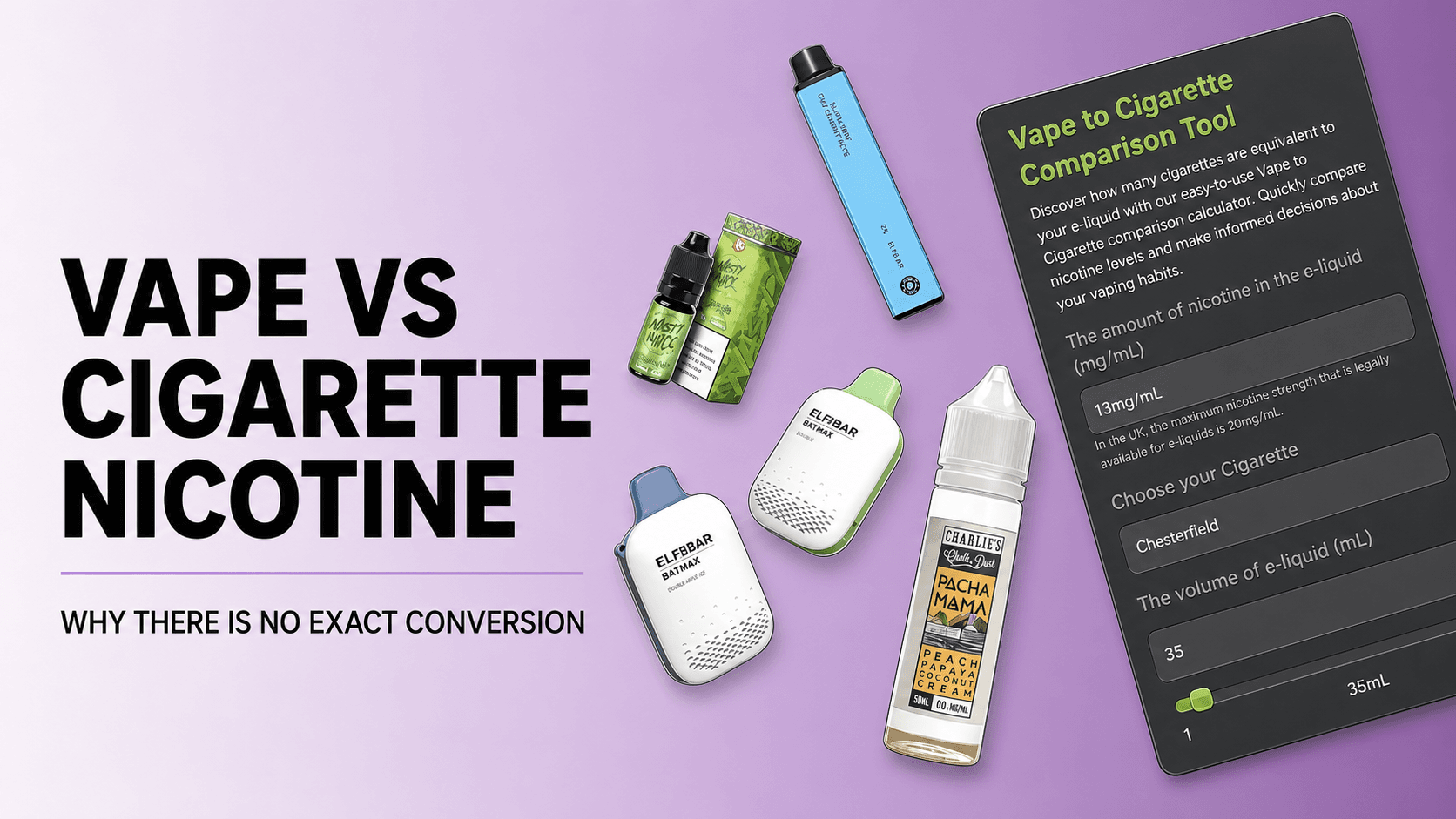
There is no reliable fixed conversion between a vape pod, a vape puff, and a number of cigarettes. An e-liquid label such as 20mg/ml states nicotine concentration in the liquid. Multiplying that concentration by the liquid volume gives the total nicotine contained in the liquid, not the amount a person will absorb.
Delivery and absorption vary with device type, power, nicotine formulation, puff duration, frequency, user experience, and how much liquid remains unused. Cigarettes vary too. For an adult trying to stop smoking, the useful question is whether the chosen treatment controls cravings well enough to support a complete switch, not whether a pod can be marketed as exactly one packet.
Key points
- Milligrams per millilitre states liquid concentration, not the amount absorbed into the bloodstream.
- Concentration multiplied by liquid volume gives total nicotine content in the container.
- Device, formulation, puffing, experience, and unused liquid all change nicotine delivery.
- A puff count is not a dose unit and a pod is not reliably equal to one packet of cigarettes.
- Adults switching from smoking should use support and craving control rather than a rigid cigarette-count chart.
Nicotine labels answer a packaging question, not a human-dose question. Confusion begins when the amount in a container is treated as the amount absorbed, then translated into a cigarette count without accounting for the device or the person.
This guide keeps the useful arithmetic and removes the false promise. If you are planning a quit attempt, use the practical stop-smoking plan. For relative health risk, read the smoking and vaping evidence comparison. For liquid formats, see how to choose e-liquid.
Read an e-liquid nicotine label in three steps
1. Concentration: a label of 20mg/ml means the liquid contains 20 milligrams of nicotine in each millilitre. In the UK, nicotine-containing consumer e-liquid is restricted to no more than 20mg/ml.
2. Volume: the container or pod states how many millilitres of liquid it holds. A 2ml pod and a 10ml refill bottle can share the same concentration while containing different total amounts.
3. Total content: multiply concentration by volume. A 2ml pod at 20mg/ml contains 40mg of nicotine in its liquid. A 10ml bottle at 10mg/ml contains 100mg in the full bottle. This arithmetic describes the product before use. It does not say that every milligram is aerosolised, inhaled, or absorbed.
Writing 20mg without the per-millilitre context is common retail shorthand, but the concentration unit matters. Check the full label rather than assuming the number describes an entire pod or bottle.
Exact liquid-content examples
| Comparison point | Concentration | Liquid volume | Total nicotine in liquid | What remains unknown |
|---|---|---|---|---|
| Lower-strength pod | 10mg/ml | 2ml | 20mg | Aerosolised, inhaled, and absorbed amount |
| Maximum-strength UK pod example | 20mg/ml | 2ml | 40mg | Aerosolised, inhaled, and absorbed amount |
| Refill bottle example | 10mg/ml | 10ml | 100mg | How many sessions and days the bottle covers |
| Maximum-strength refill example | 20mg/ml | 10ml | 200mg | Aerosolised, inhaled, absorbed, and retained amount |
Important context: The multiplication is exact for labelled liquid content. None of these rows establishes cigarette equivalence or a personal dose.
Why the same label can deliver different nicotine exposure
The OHID evidence update found conclusive evidence that nicotine intake from vaping varies. Delivery tended to rise with higher liquid concentration, nicotine-salt formulations, some device types, and more experienced puffing behaviour. Vaping generally reached its nicotine peak more slowly than smoking, but the timing and level changed with the product.
Over short sessions, vaping often produced lower peak and overall nicotine levels than smoking. Over longer periods, experienced users could reach nicotine exposure comparable with smoking by changing how often, how long, or how intensively they puffed. This adaptive behaviour is one reason a container cannot be converted into a fixed cigarette count.
OHID 2022 nicotine evidence summaryEvidence checked 2026-08-06
Limitation: Study designs, devices, users, and exposure periods varied. The review supports variability, not a universal personal prediction.
Nicotine salt and freebase are not interchangeable labels
Nicotine salt and freebase liquid can have the same mg/ml concentration while feeling and delivering differently in a given device. The OHID review found that salt-based products tended to increase nicotine exposure compared with freebase products in the pharmacokinetic studies it examined.
That does not make every salt liquid stronger in every circumstance. Device output, airflow, coil, puffing, and concentration still interact. It also does not mean a higher-delivery product is universally better. For an adult switching from smoking, adequate delivery can help replace cigarettes; for a non-smoker, it can establish nicotine dependence without a harm-reduction benefit.
Use only a liquid composition and resistance supported by the device or pod instructions. A high concentration is not intended for every high-power setup, and a retail article should not override manufacturer limits.
Use the label according to your starting point
If you smoke and are planning a complete switch
Choose with stop-smoking support, not a conversion chart
An adviser can consider dependence, previous attempts, time to the first cigarette, device choice, and whether cravings are controlled after the switch.
Watch for: Cigarettes per day is relevant context but cannot prescribe one universal strength.
If you vape and want to understand a new product label
Compare concentration, volume, formulation, and compatible device
These four facts describe the product more honestly than a puff or cigarette-equivalence headline.
Watch for: They still do not predict exactly how much nicotine you will absorb.
If you have never smoked
Do not use nicotine vaping as an experiment
The smoking comparison provides no health benefit to someone who does not smoke, while nicotine can create dependence.
Watch for: Vaping and nicotine products are not for children or under-18s.
What the UK limits mean
For nicotine-containing consumer products, UK rules restrict tank or cartridge capacity to 2ml, nicotine refill containers to 10ml, and nicotine concentration to 20mg/ml. They also require product notification, labelling, and child-resistant and tamper-evident packaging.
These are product rules, not recommended personal doses. The 20mg/ml limit is a maximum concentration for a regulated consumer product, not a target for every adult. A 2ml capacity limit is not evidence that every pod delivers the same nicotine.
Keep all nicotine liquid and filled pods away from children and pets. Follow the label and device instructions. If you feel unwell or suspect an adverse reaction, stop relying on online dose comparisons and seek appropriate medical advice.
Common nicotine comparison questions
How many cigarettes are in a 20mg 2ml vape?
There is no fixed equivalent. The pod contains 40mg of nicotine in its liquid, but the aerosolised, inhaled, and absorbed amount varies. Cigarette nicotine delivery also varies. Calling it one packet confuses product content with human exposure.
How many vape puffs equal one cigarette?
No reliable universal number exists. Puff length, volume, device output, liquid formulation, concentration, and the user all alter delivery. A marketing puff count is not a nicotine-dose unit.
Does 20mg mean 20mg in the whole pod?
Usually the full unit is 20mg/ml. Check the label. If a pod holds 2ml at 20mg/ml, it contains 40mg of nicotine in the liquid before use.
Is 20mg intended for everyone who smoked 20 cigarettes a day?
No. Cigarette count is only one part of dependence. Time to the first cigarette, prior attempts, device delivery, puffing, and personal response matter. Use stop-smoking support instead of treating a chart as a prescription.
Can a lower-strength liquid deliver more nicotine?
It can in some patterns of use because device output and compensatory puffing matter. OHID found that experienced users can change puff frequency, duration, or volume in response to lower concentrations. Concentration alone does not determine total exposure.
Is nicotine the main cause of smoking-related cancer?
No. Nicotine drives dependence, but the NHS says most smoking harm comes from the many other toxic chemicals in tobacco smoke. This distinction does not make nicotine harmless or appropriate for non-smokers.
Live products, prices and stock
This article explains the question or review. Use the linked shop pages for current product options, prices and availability.
Related reading
Sources and verification
- Nicotine vaping in England: 2022 evidence update summaryOffice for Health Improvement and DisparitiesPublished or updated: 29 September 2022Checked: 6 August 2026
Supports: Variation in nicotine delivery by concentration, salt formulation, device, experience, and puffing behaviour, plus short-term and longer-term exposure findings.
- Chapter 4: nicotine dose guidance for Great BritainMedicines and Healthcare products Regulatory AgencyPublished or updated: 16 August 2024Checked: 6 August 2026
Supports: Regulatory testing and reporting of nicotine delivery, uptake, and dose consistency for notified vaping products.
- E-cigarettes: regulations for consumer productsMedicines and Healthcare products Regulatory AgencyPublished or updated: 16 August 2024Checked: 6 August 2026
Supports: UK limits for nicotine concentration, tank or cartridge capacity, refill-container volume, packaging, and notification.
- Using e-cigarettes to stop smokingNHSPublished or updated: 15 July 2026Checked: 6 August 2026
Supports: Nicotine strength should reflect smoking need, expert support improves a quit attempt, vaping is not risk-free, and complete switching matters.
Editorial record
- Last reviewed
- 6 August 2026
- Next review due
- 10 November 2026
What changed
Removed the pod-equals-pack rule, puffs-per-cigarette estimate, cigarette-count strength prescription, and self-diagnosis advice. Added exact label maths, delivery variables, regulatory context, and a support-led decision framework.
Disclosure
Vape Forest sells nicotine products. This guide explains labels and evidence but does not calculate a personal nicotine dose, diagnose dependence, or prescribe a strength.