The short answer
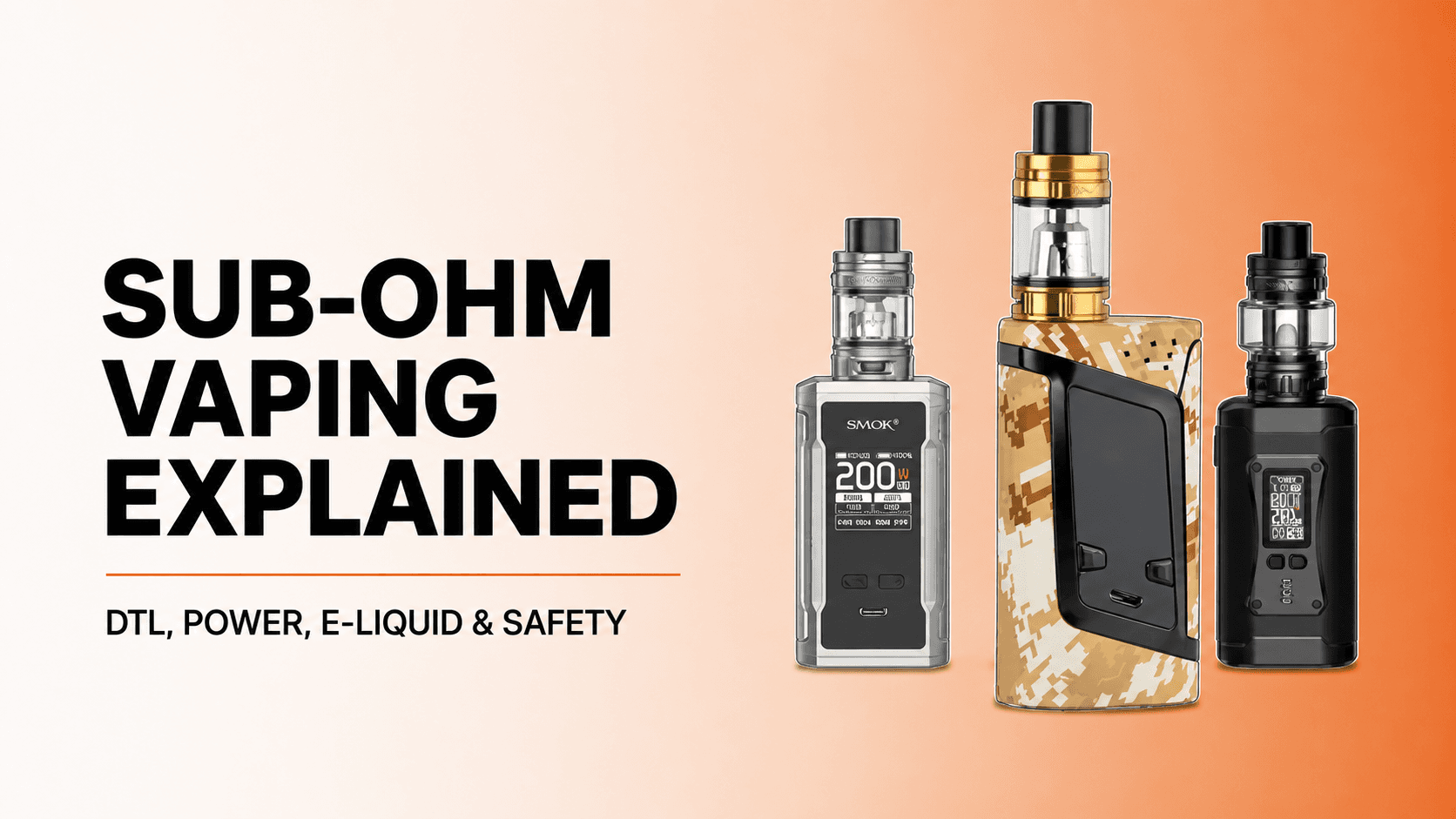
Sub-ohm means that the atomiser coil has a resistance below one ohm. In current regulated devices, it commonly appears with open airflow, direct-to-lung inhaling, higher power, and greater aerosol and liquid use than a compact MTL pod. Resistance alone does not define the experience or a safe setting: the coil’s supported power range, device protections, airflow, liquid supply, nicotine plan, and battery condition must work together.
Sub-ohm is not automatically better and is rarely the simplest first format for an adult trying to replace cigarettes. Use the live sub-ohm vape kits category for current products. This guide owns the technical explanation and suitability checks.
Key points
- Sub-ohm describes a coil below one ohm; it does not by itself define power, airflow, aerosol, or safety.
- DTL sub-ohm use commonly involves more airflow, power, liquid consumption, and aerosol than MTL use.
- Use the exact coil range and device instructions, not a generic resistance-to-wattage chart.
- Nicotine delivery varies, so a strength suitable in one format may not feel suitable in another.
- External batteries require verified cells, intact wraps, correct pairing where applicable, and protected transport.
Ohms measure electrical resistance. The term “sub-ohm” supplies only a threshold, not a complete operating instruction. Two coils below one ohm can have different materials, surface area, wicking, airflow needs, and manufacturer-supported power ranges. Using one number to infer cloud size, flavour quality, nicotine delivery, or safety is unreliable.
Most modern sub-ohm setups are used for DTL inhaling, but the concepts are separate. Read MTL versus RDL versus DTL for draw style and the e-liquid selection guide for viscosity and nicotine-format choices.
Sub-ohm DTL and compact MTL solve different jobs
| Comparison point | Typical operating pattern | Practical effect | Main risk to manage |
|---|---|---|---|
| Compact MTL pod | Tighter airflow, lower output, smaller draws | Lower liquid use and a cigarette-like inhale for many switchers | Cravings if nicotine delivery or frequency is inadequate |
| Regulated sub-ohm DTL kit | Open airflow, direct lung inhale, coil-specific higher output | More aerosol, faster liquid use, and a different sensory pattern | Incompatible liquid or nicotine plan, dry wicking, heat, and battery load |
| Mechanical or unsupported build | No regulated safety layer or use outside documented limits | Not a consumer shortcut to more performance | Short circuit, excessive current, overheating, venting, fire, and serious injury |
Important context: These are common patterns, not laws of resistance. Follow the exact supported range and airflow design of the installed coil and device.
Set up a regulated sub-ohm kit safely
Read the device and coil markings
Confirm the exact coil identity, supported range, compatible tank, battery requirements, filling route, and airflow instructions.
Check the liquid and nicotine plan
Use liquid compatible with the wicking design. Because higher-output use can change delivery and consumption, seek individual advice rather than copying a strength from an MTL setup.
Prime and fill exactly as instructed
Saturate a new coil if the manufacturer requires it, fill through the correct port, close seals, and allow the stated preparation time.
Begin within the supported range
Start conservatively within the printed range, keep airflow appropriate, and stop if the draw is burnt, unusually hot, leaking, or unstable.
Inspect and maintain the whole system
Check seals, coil seating, contacts, liquid level, battery wraps, charging behaviour, and device temperature. Replace damaged or worn components.
Who should consider sub-ohm and who should skip it
If you already vape DTL and understand coil and battery instructions
A regulated sub-ohm system may fit your established inhale and maintenance routine
It is designed around open airflow, replaceable coils, and supported output ranges.
Watch for: Expect greater liquid use, more maintenance, and a fresh nicotine assessment.
If you smoke and want the simplest first quit setup
Assess a straightforward MTL pod before defaulting to sub-ohm
A simpler, tighter-draw device is often easier to learn and use consistently.
Watch for: If it does not control cravings or feels unsuitable, review the full setup with a Stop Smoking Service rather than assuming more power is the answer.
If you cannot verify a battery, coil, or supported setting
Do not use the setup until the exact compatibility is confirmed
Resistance alone cannot establish safe current, power, temperature, or component condition.
Watch for: A forum chart, colour, or physical fit is not a substitute for the exact manufacturer documentation.
Battery and heat safety are part of sub-ohm use
Use genuine recommended cells and charging equipment. Inspect wraps and contacts. Never carry a loose cell with keys or coins, charge unattended or overnight, expose batteries to extreme temperatures, or use a damaged, leaking, swollen, or unidentified cell. Use a protective case for spares.
A burnt draw, unexpected heat, repeated error, sudden loss of liquid, or damaged seal is a stop signal. Turn the device off, let it cool, and inspect it using the instructions. Do not keep increasing power. For a fire, injury, severe breathing problem, chest pain, or another emergency, use emergency services. Report suspected product defects through MHRA Yellow Card.
Sub-ohm questions
What does sub-ohm mean?
It means the installed atomiser coil has electrical resistance below one ohm. It does not by itself specify a safe wattage, inhale, liquid, or nicotine strength.
Is sub-ohm the same as DTL?
No. Sub-ohm describes resistance; DTL describes how aerosol is inhaled. They often occur together in current products, but one does not define the other.
Does a lower resistance always make more vapour?
No. Aerosol output also depends on power, coil design, surface area, airflow, wicking, liquid, temperature, and the draw. Compare the complete supported system.
Can I use the same nicotine strength as in my pod?
Do not assume so. Device output, liquid formulation, inhaling, and frequency change delivery. Seek advice and respond to cravings or side effects rather than copying a label.
Can a beginner use a sub-ohm kit?
A regulated kit can be learned, but it adds compatibility, power, liquid, and battery decisions. A simple MTL pod is often a lower-complexity starting point for an adult switching from cigarettes.
Live products, prices and stock
This article explains the question or review. Use the linked shop pages for current product options, prices and availability.
Related reading
Sources and verification
- Vaping: a guide for health and social care professionalsNational Centre for Smoking Cessation and TrainingChecked: 8 August 2026
Supports: Device types, open-system characteristics, nicotine delivery, technique, and user considerations.
- Nicotine vaping in England: 2022 evidence update summaryOffice for Health Improvement and DisparitiesPublished or updated: 29 September 2022Checked: 8 August 2026
Supports: Evidence that nicotine and exposure vary with device type, concentration, experience, settings, and behaviour.
- Take charge of battery safety when using e-cigarettesOffice for Product Safety and StandardsPublished or updated: 17 February 2020Checked: 8 August 2026
Supports: Recommended batteries and chargers, cell transport, inspection, temperature, and safety-feature advice.
- Testing of vape batteriesOffice for Product Safety and StandardsPublished or updated: 7 March 2023Checked: 8 August 2026
Supports: Independent 18650 cell testing under cycling, pulsed discharge, overcharge, and short-circuit conditions.
- E-cigarettes: regulations for consumer productsMedicines and Healthcare products Regulatory AgencyChecked: 8 August 2026
Supports: Consumer product requirements, nicotine limits, notification, labelling, and safety reporting.
Editorial record
- Last reviewed
- 8 August 2026
- Next review due
- 8 December 2026
What changed
Rebuilt the legacy overview around the precise resistance definition, DTL context, supported power, aerosol and nicotine variability, liquid and coil compatibility, battery safety, and clear skip conditions.
Disclosure
Vape Forest sells sub-ohm kits, coils, batteries, and e-liquid. This guide does not rank products, prescribe a wattage or nicotine strength, or treat manufacturer ranges as independent performance tests.