The short answer
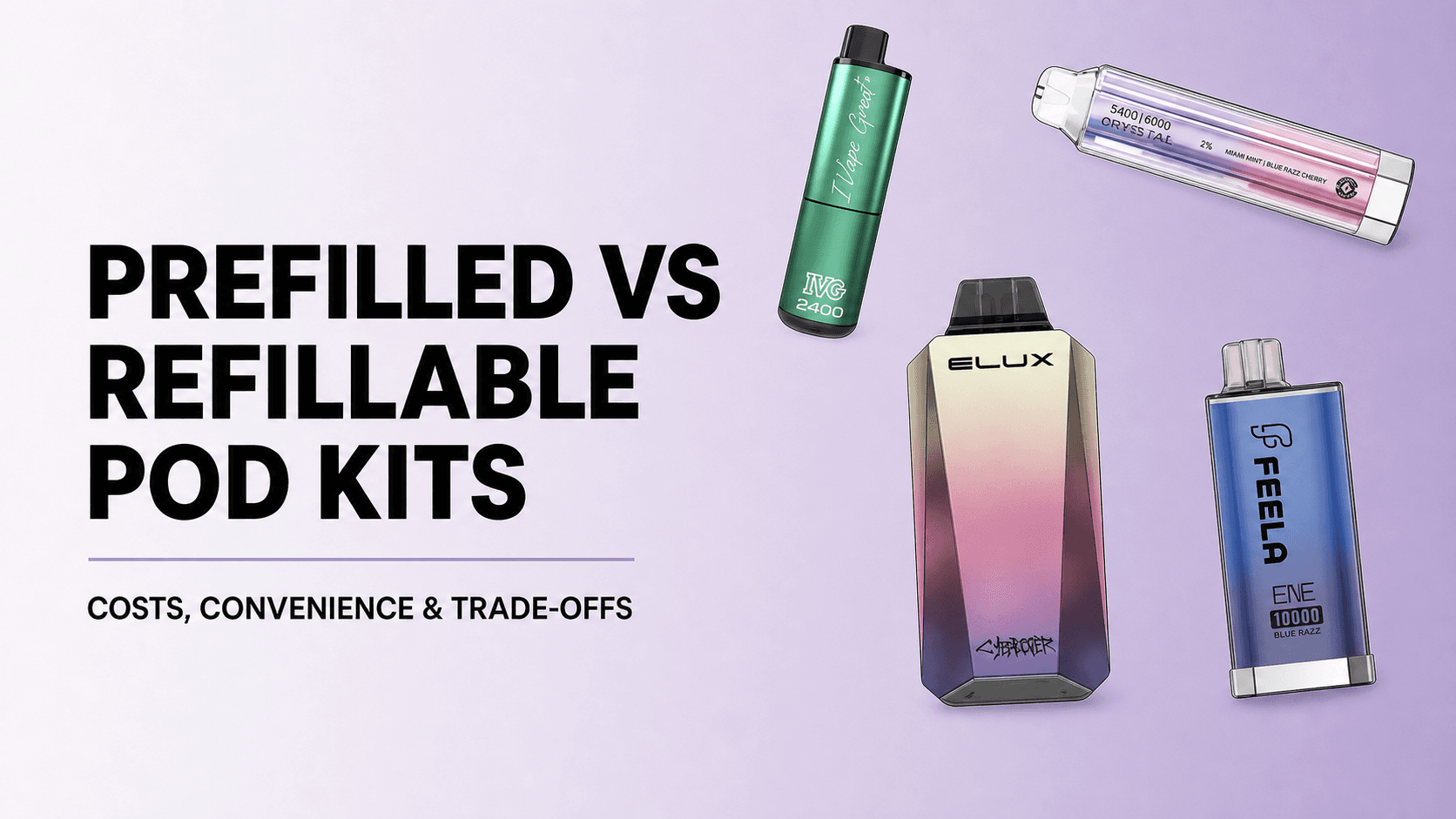
A reusable prefilled pod kit keeps the battery body and replaces a sealed liquid pod; an open refillable kit keeps the battery body and lets the user fill a pod or tank from a bottle. Both can be legal after the UK single-use-vape ban, but rechargeable is not enough. Under current government guidance, a reusable vape needs a rechargeable battery, a refillable container, and a user-replaceable coil where a coil is present. Prefilled replacement pods and coil-containing pods must be separately available.
Prefilled systems reduce filling and compatibility decisions but restrict the user to one pod range, its available nicotine strengths, and its continuing supply. Open refillables offer more liquid choice and can reduce packaging and running cost, but require filling, compatibility checks, and pod or coil maintenance. Compare the exact parts, liquid volume, nicotine options, price per ml, and recycling route rather than deciding from a puff headline.
Key points
- A rechargeable battery alone does not make a vape reusable under the single-use ban guidance.
- A closed prefilled pod can count as refillable when replacement prefilled pods are separately available.
- If a device contains a coil, the user must be able to replace it directly or within a separately available pod, cartridge, or tank.
- Prefilled reduces filling decisions; open refillable expands liquid and nicotine choice but adds compatibility and maintenance tasks.
- From 1 October 2026, Vaping Products Duty is based on liquid volume, so compare the same number of millilitres across formats.
The 2025 single-use ban did not turn every rechargeable device into the same category. A closed prefilled pod system, a prefilled kit with an external refill container, and an open refillable pod can all retain a rechargeable battery body, yet differ in how the liquid and coil are replaced.
That distinction controls convenience, choice, cost, waste, and the risk of being locked into discontinued consumables. It also controls whether the product meets the current reuse test. Use the full single-use ban guide for enforcement and edge cases. This comparison focuses on choosing between reusable formats.
Do not collapse three reusable formats into one
| Comparison point | How liquid is replaced | How the coil is replaced | Main tradeoff |
|---|---|---|---|
| Closed prefilled pod kit | Insert a new sealed prefilled pod sold for the device | Usually replace the coil as part of that pod | Least filling effort, but choice and future use depend on one pod ecosystem |
| Prefilled pod plus refill-container system | A prefilled pod works with one or more separately supplied refill containers | Replace the supported pod or other stated coil-containing part | More liquid per pack, but setup, claimed puff count, and part availability need careful checking |
| Open refillable pod or tank | Fill from a compatible e-liquid bottle | Replace a coil or an integrated-coil pod | Broadest liquid choice, but the user manages filling, ratio, nicotine, and upkeep |
Important context: The marketing terms big puff, disposable alternative, and pod kit do not establish legal reuse. Apply the component test to the exact product.
Check whether a prefilled kit is genuinely reusable
Confirm the battery can be recharged
Find the charging input and instructions. A light, screen, or charging-looking shape is not evidence by itself.
Identify the replaceable liquid container
The user must be able to refill a tank or cartridge with liquid or insert a new prefilled pod, capsule, cartridge, or other supported container.
Identify how the coil is replaced
Where a coil is present, the user must be able to replace it directly or by replacing the pod, tank, or cartridge that contains it.
Verify every refill and coil part is separately available
Find the actual compatible replacement item for sale, not only a launch promise or a bundled part. Record the exact model and part identity.
Check the other product rules separately
Reusable status does not establish nicotine limits, tank and refill presentation, MHRA publication, labelling, packaging, electrical safety, or authenticity.
Prefilled and open refillable compared without puff marketing
| Comparison point | Reusable prefilled system | Open refillable system | What to verify |
|---|---|---|---|
| Daily setup | Insert the supported sealed pod or refill assembly | Open the fill port, add a compatible bottle, and manage the seal | Dexterity, spill tolerance, eyesight, instructions, and part orientation |
| Compatibility | Manufacturer pairs the pod, coil, liquid, and device | User matches ratio, nicotine, pod or coil, and power | Exact device family and supported consumables, not appearance |
| Nicotine and flavour choice | Limited to the concentrations and flavours released for that platform | Broader legal bottle selection within hardware limits | Current stock, exact strength, salt or freebase, and suitability for the smoking goal |
| Supply dependency | Battery body depends on continued supply of proprietary pods and coil parts | Device can often use multiple liquid brands but still depends on compatible pods or coils | Replacement availability, cross-generation compatibility, and discontinuation plan |
| Waste | Retains the battery but discards sealed pods and refill components | Retains the battery and tank or pod body until coil or pod replacement, plus bottles | Actual replacement rate, materials, local recycling, and retailer takeback |
| Cost | Device plus proprietary pods or refill assemblies | Device plus bottles and replacement pods or coils | Same time window, same liquid volume, current prices, failures, delivery, and duty date |
Important context: No universal monthly figure is credible without usage and current price inputs. A puff headline is not a standard unit of liquid, nicotine, duration, or value.
Compare cost by volume and replacement cycle, not advertised puffs
Choose a common period, such as 30 days, and record the liquid actually used. For a prefilled system, add the battery kit cost allocated across its realistic service period, every pod or refill assembly, delivery, and any failed or wasted part. For an open system, add the allocated device cost, bottles, replacement pods or coils, and the same extras.
Then show both total cost and cost per millilitre. Keep nicotine concentration separate. A lower cost per ml does not mean the right nicotine dose or device, and a high puff claim cannot replace measured liquid volume because draw length, power, airflow, and user behaviour change the result.
From 1 October 2026, Vaping Products Duty is 22 pence per ml. HMRC gives liabilities of 44 pence for a 2ml pod and £2.20 for a 10ml refill bottle. The same volume-based rate applies regardless of nicotine. Retail prices may not move by exactly the duty amount, so label every comparison as before or after the duty date and refresh the live prices.
Prefilled does not create one standard nicotine experience
Prefilled pod systems often use nicotine salt, but available concentrations and formulations vary. OHID found that nicotine exposure changes with concentration, salt or freebase formulation, device type, experience, and puffing. It also found compensatory behaviour, where users can take longer, larger, or more frequent puffs with lower concentrations.
Do not describe a 20mg/ml pod as automatically equivalent to a single-use product or cigarette. Do not assume a lower concentration guarantees a lower daily dose. An adult switching from smoking needs enough nicotine to control withdrawal in a suitable device, while a non-smoker should not start.
OHID 2022 nicotine evidence summaryEvidence checked 2026-08-06
Limitation: The evidence does not prescribe an individual concentration or predict delivery from a product category without the exact liquid, device, and use pattern.
Reusable still needs charging, liquid, and waste discipline
Use the supplied or manufacturer-approved charging arrangement and do not leave a vape charging unattended or overnight. Stop using a device that becomes unusually hot, swells, hisses, activates by itself, leaks badly, or is physically damaged. Keep liquid and used pods away from children and pets.
A sealed pod reduces filling contact but can still leak or be inserted incorrectly. An open pod adds bottle handling and fill-port errors. Whichever format you use, follow the exact instructions, wipe spills as directed, wash exposed skin, and seek appropriate medical advice for suspected poisoning or concerning symptoms.
All vapes are electrical equipment. Do not put the battery device in household rubbish or household recycling. DEFRA says vape distributors must offer takeback for vapes and parts, and GOV.UK WEEE guidance describes current retailer obligations. Follow local instructions for pods and bottles because material and contamination rules vary.
Choose by the friction you can manage
If you smoke and filling or coil choices would stop you trying to switch
Consider a simple reusable prefilled pod with reliable replacement supply
Reducing setup tasks can support early use, while retaining and recharging the battery avoids the banned single-use format.
Watch for: Check nicotine choice with a stop-smoking adviser and verify pods and coil parts are separately available.
If you want broad flavour or nicotine choice and can fill a pod
Choose a straightforward open refillable system
Bottled liquid separates the hardware from one proprietary flavour list and allows more ratio and concentration options within device guidance.
Watch for: Use the <a href="/vape-guide/e-liquid/e-liquid-selection-guidelines/">e-liquid selection guide</a>; wrong viscosity, strength, or power can create problems.
If you care most about long-term cost
Calculate both formats from your measured monthly liquid use
Volume, replacement interval, stock price, failures, and device lifetime determine the result more reliably than a generic monthly estimate.
Watch for: Repeat the calculation after 1 October 2026 and distinguish duty from retailer pricing decisions.
If the replacement pods or coils are hard to find
Do not buy the battery body until supply is verified
A reusable design has little practical value if the user cannot buy the exact replacement liquid container and coil part.
Watch for: A retailer listing can go out of stock. Check manufacturer support and more than one accountable supplier.
Common prefilled and refillable questions
Are prefilled pod kits legal after the disposable-vape ban?
They can be when the exact product meets the reuse test: rechargeable battery, refillable or replaceable liquid container, and user-replaceable coil where present, with the refill and coil items separately available. “Prefilled” alone does not decide legality.
Does a charging port make a vape reusable?
No. It also needs a liquid container the user can refill or replace and a coil the user can replace directly or within a replacement pod or tank, where a coil is present.
Is a prefilled pod the same as a disposable vape?
No. A separately available prefilled pod can be the refill for a reusable battery system. A single-use vape is a complete product that fails the current battery, refill, or coil reuse requirements.
Are prefilled kits maintenance-free?
No. They reduce filling and coil-selection tasks but still need charging, contact cleaning, leak checks, correct pod insertion, storage, battery inspection, and replacement consumables.
Are refillable kits always cheaper?
Often, but not as a universal claim. Compare device cost, measured liquid use, bottle or pod prices, replacement parts, failures, delivery, and device lifetime over the same period. Use cost per ml rather than advertised puffs.
Do all prefilled kits use 20mg nicotine salt?
No. Product ranges differ, and stock can change. Check the exact pod label and MHRA-published identity. Do not choose 20mg/ml simply because it is the legal maximum or a familiar single-use strength.
Are reusable prefilled kits waste-free?
No. Retaining the battery can reduce repeated battery disposal, but pods, coils, refill containers, packaging, and an eventual battery device remain. Use retailer takeback and local recycling instructions.
Does a high puff count prove better value?
No. Puff claims vary with draw length, power, airflow, device behaviour, and test method. Compare declared liquid volume, current price, replacement parts, and your measured consumption.
How can I check a suspicious “reusable” product?
Apply the full reuse test, locate every replacement part, match the exact nicotine product to the MHRA list, and check the manufacturer and seller. The fake-vape guide explains the layered checks.
Live products, prices and stock
This article explains the question or review. Use the linked shop pages for current product options, prices and availability.
Related reading
Sources and verification
- Single-use vapes ban: information for businessesDepartment for Environment, Food and Rural AffairsPublished or updated: 3 July 2025Checked: 6 August 2026
Supports: Ban date and scope, legal reuse definition, separate availability of refills and coils, enforcement context, and vape recycling.
- E-cigarettes: regulations for consumer productsMedicines and Healthcare products Regulatory AgencyChecked: 6 August 2026
Supports: Tank and refill limits, nicotine maximum, packaging, ingredient restrictions, warnings, and notification.
- More information about the MHRAMedicines and Healthcare products Regulatory AgencyChecked: 6 August 2026
Supports: Distinction between consumer notification and product approval and the regulatory position for nicotine-free products.
- Using e-cigarettes to stop smokingNHSPublished or updated: 15 July 2026Checked: 6 August 2026
Supports: Cessation purpose, complete switching, adult and non-smoker boundaries, charging safety, and Yellow Card reporting.
- Nicotine vaping in England: 2022 evidence update summaryOffice for Health Improvement and DisparitiesPublished or updated: 29 September 2022Checked: 6 August 2026
Supports: Nicotine delivery variability by formulation, concentration, device, experience, and puffing.
- How to pay Vaping Products DutyHM Revenue and CustomsPublished or updated: 1 April 2026Checked: 6 August 2026
Supports: Flat rate of 22 pence per ml and example liabilities for 2ml pods and 10ml refill bottles from 1 October 2026.
- Regulations: Waste Electrical and Electronic EquipmentUK GovernmentPublished or updated: 12 August 2025Checked: 6 August 2026
Supports: Current electrical-waste and retailer takeback responsibilities for vapes.
Editorial record
- Last reviewed
- 6 August 2026
- Next review due
- 10 November 2026
What changed
Reframed the article around reusable prefilled and open refillable systems after the June 2025 single-use ban. Removed unsupported monthly costs, universal 20mg assumptions, product picks, maintenance-free language, puff ceilings, and environmental victory claims. Added the full reuse test, parts availability, total-cost method, October 2026 duty, waste, nicotine, and safety boundaries.
Disclosure
Vape Forest sells prefilled and open refillable systems and their consumables. This comparison does not rank a current product or assume that the format with higher retail margin is better. Prices, stock, parts availability, and product compliance must be checked at the time of purchase.